
The PitchBook Platform is home to the industry’s largest set of private company valuations—97,247 to be exact. It’s a number we’ve reached thanks to our research team’s diligent method of collecting and verifying valuations. While we stand by our best-in-class valuation data, we wondered: Is a private company valuation something that can be estimated? This question became even more pertinent as some industry players have begun incorporating estimated valuations into their datasets.
We figured if anyone could achieve accurate estimations, it’d be us. So we challenged our data science team to deliver an answer to our question. Step one: Develop a model for estimating valuations. Step two: Test their accuracy rate.
The results? Running this test validated something that we’ve believed since Day One: Estimated valuations are too far off the mark to be classified as meaningful information.
Setting up the Test
The variables we selected for our test model were picked assuming that similar companies would have similar valuations, including:
- Data from current round
- Data on previous rounds
- Industry data
- Data on participating investors
- Location
We then pulled all our VC valuations from the last five years, split them into two datasets and trained three separate models to test accuracy rates.
We’ll walk you through the best-performing model. For a more in-depth look at the other tests, check out PitchBook data analyst Nathan Eyre’s post.
Our Process and Results
By running our variables through a random forest regressor, we found that only 39.67% of the companies tested fell within 15% of their actual verified company valuation.
For most professionals, a 15% accuracy threshold is likely the highest that could be used to conduct business with any degree of confidence. But with only about 40% of test cases falling within that range, there’s another 60% that have an accuracy rate well outside of that 15% threshold.
That means it’s impossible to know whether the estimation is part of the 40% success rate or belongs to the 60% failure rate.
What We Learned
Our tests yielded an accuracy rate that is simply too low for us to endorse. We conclude that estimated valuations cannot provide the level of precision our clients need. We’ll keep doing what we’ve always done and we recommend caveat emptor should you ever encounter estimated valuations for private companies.
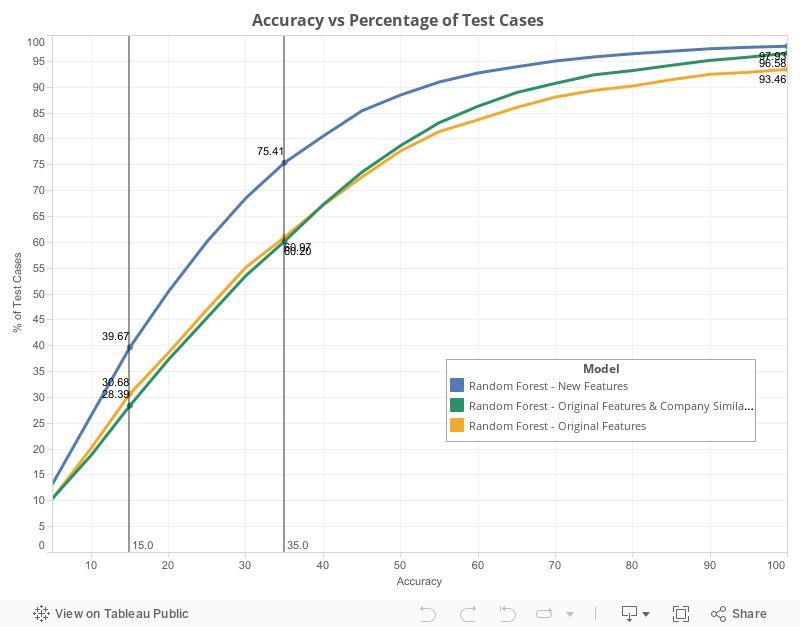
The data visualization shows the accuracy of our test models. The X-axis is the accuracy threshold and the Y-axis is the percent of companies that fall within that threshold. For example, if we wanted to see how many rounds had a predicted valuation within 15% of their actual valuation, we would see that 39.67% of test cases fall within this threshold, as per our final model.
How PitchBook Calculates Valuations
It’s not hard to understand why estimated valuations are difficult to predict. Early-stage company valuations are often driven by subjective factors and estimates, while later-stage companies have more quantifiable data to work with like operating statistics and performance indicators.
The weight given to these factors varies from investor to investor and company to company. These subjective factors and weights are difficult to measure and quantify, making it extremely difficult to estimate valuations.
The PitchBook method for calculating a valuation is much more accurate. We start with a company’s cap table and series terms. Our analysts use a proprietary formula that’s similar to calculating market cap for publicly traded companies and incorporate factors like issued number of shares and option pool estimates. With this formula, we’re able to come to a conclusive number that, based off feedback, falls within a 5% margin of error.
Most importantly, our primary research team contacts the company’s investors and executives directly to confirm the information we’ve collected.
Your Next Steps
No matter which provider you use for private company valuations, we’d encourage you to reach out and explore where those valuations come from. If you’d like to learn more about our process, our platform and our valuations data, give us a call or request a free trial.
[Related post: The data science behind testing estimated valuations]