

Prior to the 2008 financial crisis, most lenders to US PE-backed companies were banks. Today though, the private debt landscape—where debt is typically extended to a private company by a non-bank institution—is growing. The increased prevalence of private debt fundraising can be attributed to a variety of strategies, but the steady expansion in direct lending investment vehicles is perhaps most noteworthy.
In recent PitchBook Blog posts, we’ve looked at the ins and outs of private debt and at the firms leading the private debt market. Today, we’ll highlight the post-global financial crisis regulatory environment and how milestones within it cultivated demand for financing opportunities from non-bank lenders.
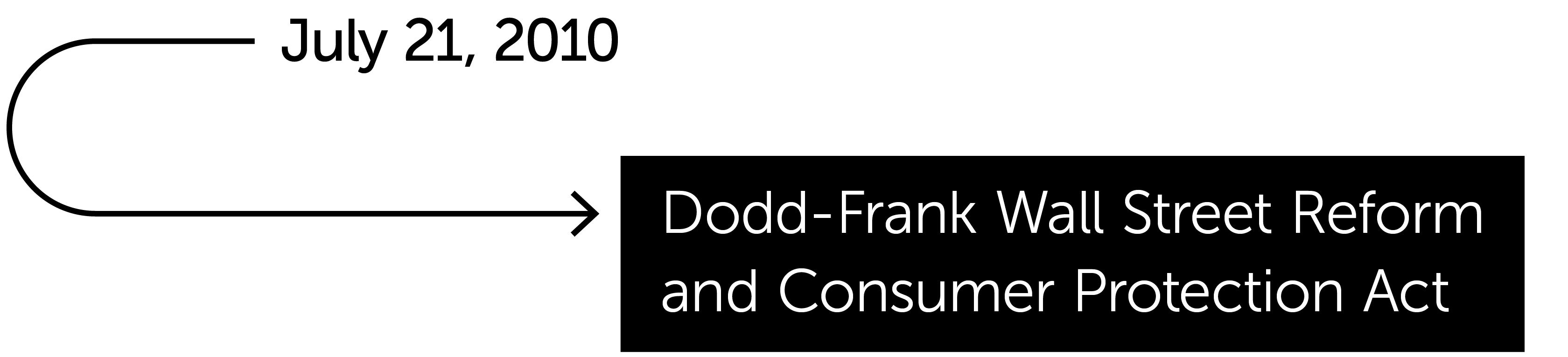
Date enacted
July 21, 2010
Involved parties
Former United States Senator Christopher J. Dodd (D-Conn.) and former US Representative Barney Frank (D-Mass.)
What is it?
The Dodd-Frank Act is a piece of financial reform legislation passed in response to the financial crisis under US President Barack Obama. The act includes 16 titles covering a range of topics related to mostly globally relevant themes—like financial stability, Wall Street transparency and accountability and investor protection. The Dodd-Frank Act established new agencies tasked with overseeing individual pieces of the act and therefore aspects of the financial system, too. In 2016, then-US presidential candidate Donald Trump campaigned on dismantling Dodd-Frank, and in 2018, he signed a law to roll back large portions of it.
Private debt impacts
A relevant component of Dodd-Frank for private market professionals is the controversial Volcker rule, which limited proprietary trading—when financial institutions make investments with their own money—and banks' exposure to equity positions in PE and hedge funds. Banks could still lend to these funds if the debt instrument being provided did not include equity features, but limiting banks' exposure to PE still created the opportunity for non-bank financial institutions to increase capital offerings to PE funds.

Release date
December 2010
Involved parties
The Basel Committee for Banking Supervision (BCBS), which is a committee of banking supervisory authorities established in 1974 by the Group of Ten countries' central bank governors. In 2019, the committee consists of 45 members from 28 jurisdictions. The group provides a forum for regular cooperation on all matters related to banking supervisory.
What is it?
According to the Bank for International Settlements, Basel III is an internationally agreed upon set of measures developed by the BCBS in response to the financial crisis. The measures included in Basel III are intended to strengthen the regulation, supervision and risk management of banks. Like all BCBS' standards, Basel III outlines volunteer minimum requirements that apply to banks that are active globally.
Private debt impacts
The BSBS has long governed the international banking system, but the Basel III has had the largest impact on private debt funds. Informed by the global financial crisis, Basel III's writers wanted to protect the banking sector—and, as a result, the economy—by placing capital requirements on systemically important banks. Basel III restricted the lending of those banks, including JP Morgan Chase and Bank of America among others, and therefore expanded the market demand for non-bank sources of debt financing.

Release date
March 2013
Involved parties
The US Office of the Comptroller of the Currency (OCC), Board of Governors of the Federal Reserve System and Federal Deposit Insurance Corporation (FDIC).
What is it?
The Final Joint Guidance on Leveraged Lending intended to ensure federally regulated financial institutions' lending activities were conducted safely. The guidance applied to national banks, federal savings associations and federal branches and agencies of foreign banks, and it helped those entities strengthen their risk management frameworks and ensure that their leveraged lending activities didn't create risk in the banking system through the distribution of poorly underwritten, low-quality loans.
Private debt impacts
The guidance on leveraged lending set an upper limit of 6.0x EBITDA for leveraged loan issuance, further limiting banks' ability to participate in the leveraged loan market. Private debt funds were not bound by these restrictions, so they were able to offer more comprehensive financing packages than traditional bank lenders. While the guidelines were not strict rules and did not apply to all banks, a 2017 decision by the Government Accountability Office rolled the guidelines back, allowing greater flexibility for banks in the leveraged loans space and creating greater competition for private debt funds deploying capital.
To learn more about private debt, check out our Analyst Note about growth in private debt fundraising.