

The accompanying data pack for this report was updated on March 5, 2026, to correct the number of Falcon 9 launches featured in the financial model.
PitchBook clients can access this report’s Excel data pack via the Research Center on the PitchBook Platform.
SpaceX is preparing for what could be the largest IPO in history, targeting a $1.5 trillion valuation and looking to raise as much as $50 billion. PitchBook’s initiation report and bottom-up financial model offer a granular, independent look at SpaceX’s financials to value the opportunity and learn about key business drivers.
Is a $1.5 trillion valuation justified?
At nearly 95x our 2025 revenue estimate of $16 billion, the valuation is rich but not irrational. Our sum-of-the-parts analysis places fair value between $1.1 trillion and $1.7 trillion, with the IPO target sitting within that range. Benchmarked against high-growth large-cap peers, SpaceX’s profile warrants a premium multiple, with around 50% EBITDA margins and around a 50% three-year revenue CAGR in addition to multiple compounding growth vectors. The valuation becomes progressively easier to justify over a 5-7 year horizon as Starship commercializes and the direct-to-cell business scales, with returns driven by milestone execution rather than near-term earnings growth.
The xAI acquisition: Reframing the story
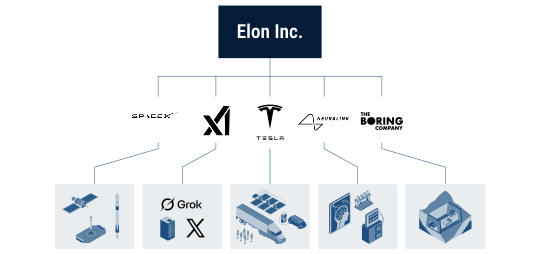
SpaceX’s February 2026 acquisition of xAI transforms its public market narrative from a rockets-and-internet company into a deeply integrated AI-and-space-infrastructure platform—exactly the profile the market is currently paying the highest premiums for. The financial contribution from xAI will be incremental in the early years, but AI businesses at this stage command significant multiples, and the synergies between SpaceX’s infrastructure and xAI’s compute ambitions reinforce a platform story that competitors have found nearly impossible to replicate.
Starlink: The cash flow engine
Starlink generated an estimated $10.6 billion in revenue and $5.8 billion in EBITDA in 2025 at a 54% margin, accounting for over two-thirds of total SpaceX revenue, having doubled its subscriber base for two consecutive years to reach 9.2 million across 150+ countries. By 2040, we forecast Starlink revenues of $120 billion at a 70% EBITDA margin, driven by the direct-to-cell opportunity scaling to 1.1 billion subscribers and hardware costs declining to near zero as a share of revenue.
Launch services: The uncontested market leader
SpaceX flew 165 Falcon 9 missions in 2025—roughly 52% of all global orbital launches—with an 84% booster reuse rate that has cut launch costs by as much as 65%, a tempo and cost structure no competitor has come close to matching. We estimate the launch business generated $5.2 billion in revenue and $1.7 billion in EBITDA in 2025 (33% margin), growing to $30 billion in revenue by 2040 as Starship takes over the entire manifest.
Starship: The next era of growth
Starship is the variable that separates a good investment from a great one—at commercial scale, the fully reusable superheavy-lift vehicle would reduce SpaceX’s cost to deploy satellite capacity by roughly 70%, unlocking a 25x increase in capacity added per launch versus current configurations. We expect the first commercial payload delivery in 2026. In the long term, we anticipate Starship will comprise the entirety of SpaceX’s launch manifest by 2040, with a temporary EBITDA trough around 2030-2031 as Falcon 9 margins phase out before Starship reusability savings fully materialize.
Direct-to-cell: Locked in before the competition gets started
Starlink’s direct-to-cell service reached 6 million subscribers through 27 carrier partnerships in roughly 18 months, and SpaceX’s $19.6 billion acquisition of EchoStar’s wireless spectrum repositioned direct-to-cell from a carrier-dependent roaming layer into a spectrum-owning platform with long-term pricing power. With a dedicated 15,000-satellite constellation filed with the US Federal Communications Commission and ecosystem partnerships already in place, SpaceX is working to become structurally embedded in global mobile infrastructure before any competitor reaches meaningful commercial scale—a window we forecast translating into 1.1 billion subscribers and $42 billion in revenue by 2040.
