

Key points
- Traditional valuation approaches—anchored in lagging financials or sparse transaction data—struggle to keep pace with the speed and complexity of modern private capital markets.
- Building on PitchBook’s quantitative valuation tools such as VC Exit Predictor, Valuation Estimates closes this transparency gap by delivering AI-powered valuation data for a large universe of VC‑backed companies.
- The model blends market trends, comparable company performance, and company‑specific signals—while clearly showing the drivers behind each estimate.
Outcome: Customers can source, complete due diligence, and monitor portfolios quicker and with greater conviction thanks to market‑informed valuations and growth trajectories that sharpen pricing and illuminate emerging opportunities.
For investors operating in today’s market, timely and trustworthy valuation methodologies mean the difference between closing a lucrative deal and missing out.
Thoroughly valuing a private company not only mitigates risk but ensures investors can price with confidence. As regulators and standard-setters increase scrutiny on private market valuation governance and transparency, the need for reliable, independent valuation insights has never been greater.
This blog introduces PitchBook’s machine learning–driven Valuation Estimates, the new standard for valuations covering a large universe of VC-backed companies. This is the newest feature in our quantitative suite of tools, which includes the VC Exit Predictor. In addition to understanding probabilistic exit outcomes, our clients can now access daily valuation estimates for thousands of private capital market companies.
Read on to discover why we built Valuation Estimates, what differentiates this feature from others, and the key drivers of our methodology, with insights from our developers.
What is PitchBook’s Valuation Estimates?
Valuation Estimates closes the opacity gap by delivering daily and growth estimates for thousands of VC-backed companies, estimating how a startup’s valuation has evolved since its last funding round.
Powered by AI-driven valuation intelligence, our proprietary model combines machine learning with best-in-class private capital market data, public market signals, and capital structure insight to support sourcing, due diligence, and portfolio monitoring across the private capital lifecycle.
With PitchBook’s best-in-class private capital market data and analytical rigor, this model enables investors to:
 |
Source deals by identifying private companies with shifting value and momentum before the next funding round. |
 |
Conduct due diligence with a market-informed estimate to assess pricing against peers and current conditions. |
 |
Support portfolio monitoring, regulatory reporting, and liquidity planning. |
Why did PitchBook build Valuation Estimates?
Private capital market professionals have long struggled with opacity in valuing private companies. Inconsistent intelligence slows deal execution, complicates reporting, and weakens confidence in portfolio monitoring.
Valuation Estimates fills the gap and need for a reliable, independent way to assess value and compare VC-backed companies with precision, especially as IPOs become more selective and LPs push for greater transparency.
Built on PitchBook’s proprietary valuation intelligence, this feature brings consistent, data-driven clarity to valuations, solving the problem of valuations that are outdated, undisclosed, or difficult to triangulate.
PitchBook customers were clear: they didn’t want another black box framework. That’s why our model surfaces key drivers, confidence levels, and historical patterns, giving clients the transparency they need to act decisively and stay ahead of fast-moving markets.
Private markets don’t have real-time prices like public markets do, so we built Valuation Estimates to give customers a reliable starting point. It’s an independent, data-driven insight that helps investors quickly understand what a company might be worth today—whether they’re sourcing a deal, marking a portfolio, or sanity-checking a valuation.
What makes our methodology stand out?
Our framework prioritizes transparency and explainability by showing how each data type contributes to the overall estimate, as well as the reasoning behind our calculations, not just the final number.
To achieve this, Valuation Estimates uses Bayesian Regression, which provides both a valuation and a measure of how confident the model is in that outcome. Whereas most models generate a single figure, Bayesian Regression enables the model to yield a valuation estimate, a confidence score, and an uncertainty range which is essential when transparency is limited.
“PitchBook’s Valuation Estimates help our customers understand how a startup’s valuation may have changed since their last primary round. This can be useful when sourcing deals, executing deals, or marking portfolios. Our model is fully transparent, allowing users to see what’s driving the changes in valuation alongside our confidence bands,” said PitchBook’s Senior Director and Global Head of Quantitative Research, Daniel Cook, CFA.
How are PitchBook Valuation Estimates calculated?
Powered by AI-driven valuation intelligence, Valuation Estimates uses machine learning to estimate a company’s expected valuation growth using three key groups of data:
 |
Market trends |
 |
Comparable company growth |
 |
Company-specific factors |
Together, these sources use the change in a company’s value from its last known valuation to generate an updated estimate of its current valuation. In addition, each company is assigned a confidence score based on its most recent known financing round with a post-valuation number.
A more recent post‑money valuation, for example, within the last three months, corresponds to a very high confidence score, as the company’s value is anchored in up‑to‑date market conditions and company performance. Conversely, if it has been a long time since a company last raised, say, more than two years ago, the confidence will be very low, because there is greater uncertainty around how its value may have changed over time.
How do Valuation Estimates look in PitchBook?
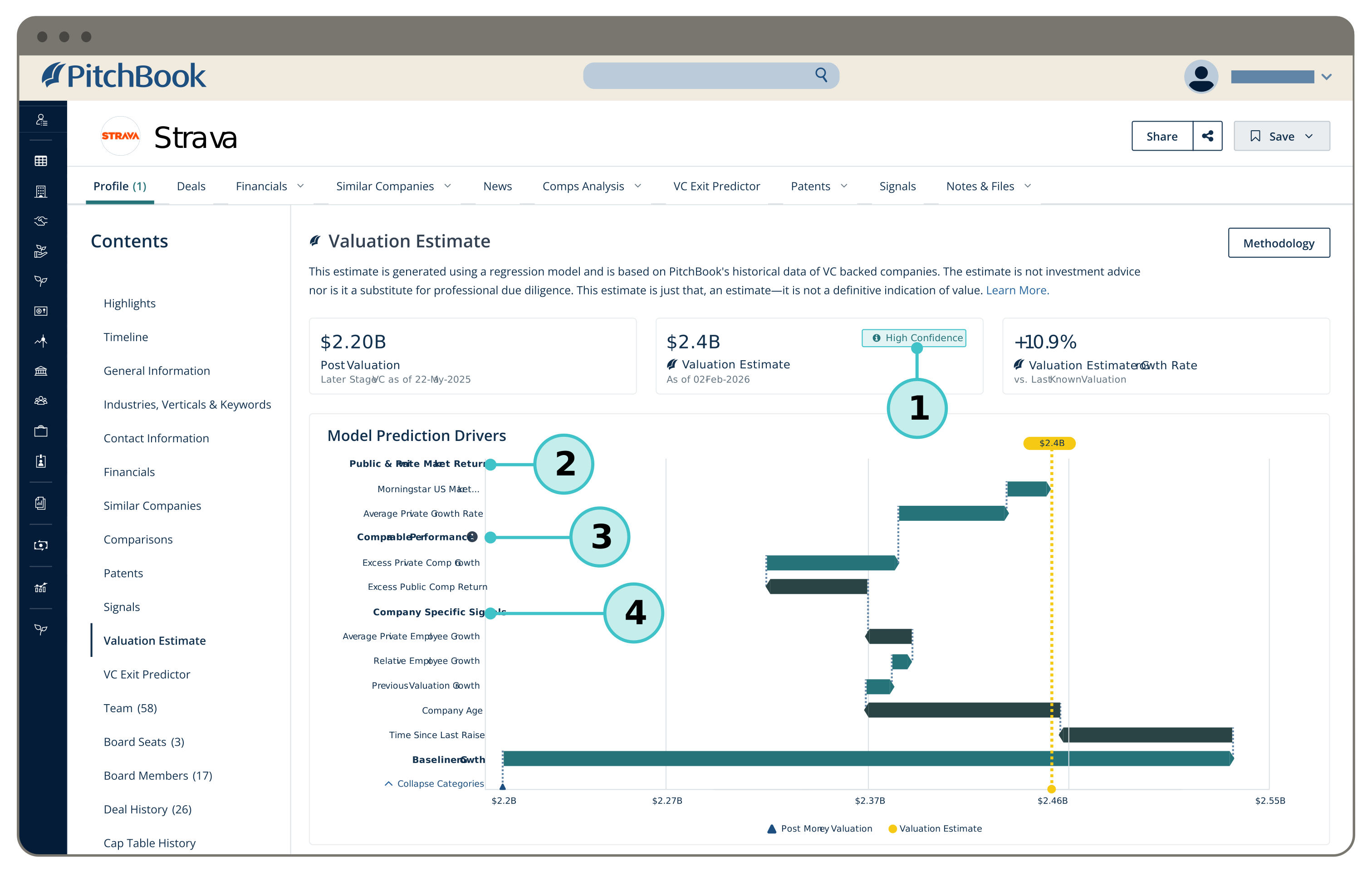
To show how Valuation Estimates works in the platform, let’s walk through an example using Strava, a San Francisco–based company founded in 2009 that built a social fitness platform connecting athletes around the world.
- Open Strava’s company profile page in PitchBook.
- On the left-hand panel, scroll down until you see Valuation Estimate.
- Click to expand the module.
- Toggle over the graphics and any displayed numbers to explore the underlying data, such as expected valuation growth, model drivers, and historical benchmarks, that inform Strava’s current Valuation Estimate.
Each category provides a clear breakdown of how each data source shaped Strava’s estimate.
*Legal disclaimer: This estimate is generated using a regression model and is based on PitchBook’s historical data of VC-backed companies. The estimate is not investment advice nor is it a substitute for professional due diligence. This estimate is just that, an estimate—it is not a definitivei ndication of value.
- Confidence score: This estimate has a high confidence score because the company’s last known valuation was within the last 12 months, resulting in a moderate estimated valuation range of $2-$3 billion. The company’s latest acquisition financing was $125 million completed in April 2025.
- Market trends: The first major model input is derived from information such as the average private growth rate and Morningstar US Market Index.
- Comparable performance: Comparable company performance is another major input to the model. It draws on company descriptions and analyst-curated verticals.
- Company specific signals: This is the third input to our valuation estimates model. These are details about the company itself.
Stay ahead in a changing market with Valuation Estimates
Our approach to Valuation Estimates has been directly shaped by the needs of our customers. At PitchBook, we move at the pace of the private capital markets, evolving alongside them to meet our clients where they are. We remain committed to empowering users to stay ahead through innovative tools, analytic rigor, and the most comprehensive data sets available.
PitchBook is the pulse of private capital markets; we’re the industry leader in private capital market intelligence. It’s important that we’re paving the way with fresh, disruptive innovation.

Move faster with clear valuation signals
Valuation Estimates delivers a consistent, independent estimate that boosts pricing confidence, accelerates diligence, and strengthens portfolio monitoring. With trusted and transparent valuation signals, investors can move faster, reduce uncertainty, and make more informed decisions in an opaque market.