

Introduction
In another blog post, we recently discussed how limited partners can build a private market asset allocation strategy in their portfolios. In this post, we’ll focus on another piece of the puzzle: cash flow management.
How can allocators either reach or maintain their target allocations—or adjust their strategies to align with current market conditions? Continue reading to learn about new tools and solutions that can help LPs manage their cash flow with confidence.
Why is cash flow management important?
It’s worth noting that private markets act differently from public market funds like mutual funds, which are more liquid. If an LP decides to commit 10 percent of its portfolio to PE drawdown funds, it can’t achieve a 10 percent allocation on the day, month, or even year of that decision. LPs make commitments, which are then drawn down over time. As the LP continues to make commitments each year, money starts to be returned from older vintages, making attaining and maintaining an allocation tricky.
This lack of control LPs have over when their capital is called or returned is the reason why cash flow management is so important. Allocators constantly need to weigh the opportunity cost of their cash exposure. LPs don’t want to have too much cash dragging down their portfolio returns, but also don’t want to over allocate to illiquid investments like PE and VC and then have to sell other investments if calls overwhelm their cash balances.
In the event that an LP does find itself in a cash crunch and liquidating other investments is unappetizing, there can be severe penalties should they decide the best course is to just not fund capital calls until the cash situation clears up. If an LP defaults on its commitment, the GP might opt to:
- Allow late payment with interest and related expenses charged back to the LP.
- Require the LP to sell its stake to other parties at a discount.
- Dilute the LP’s fund interest by redistributing some of the LP’s stake to other LPs.
- Redeem the LP’s interest with no payment or a promissory note of nominal value payable when the fund liquidates.
- Sue for damages.
What is commitment pacing?
One key component of cash flow management is commitment pacing. The goal of commitment pacing is to determine an appropriate annual schedule for allocations to various private market strategies. Commitment pacing is done in conjunction with cash flow modeling of in-ground allocations. This helps LPs understand the potential path a fund commitment might take, given certain assumptions about its growth.

Cash flow management challenges
The denominator effect
There are moments in time when it becomes difficult to maintain long-term allocations. Following the Global Financial Crisis (GFC)—and again in 2022—many allocators were concerned about the potential impact of the denominator effect.
In her Analyst Note about 2022’s market challenges, PitchBook’s Hilary Wiek, CFA, CAIA, a senior strategist for fund strategies, explains that some allocators have responded to these concerns by rewriting their investment policy statements to allow for more flexibility in their allocations (see below for a sample chart of widened target ranges).

“Because valuations can drift and because LPs don’t have a lot of control over their private market allocations due to long-term lockups in those funds, LPs might allow a strategic PE allocation of 20% to drift down to 15% and up to 25% to avoid having to do something drastic at the wrong moment like selling when the worst possible pricing environment is at hand,” Wiek further explained.
Overallocation to the private markets
In retrospect, the denominator effect largely worked itself out from 2022 to today with public markets rising back up again and some write-downs in private fund valuations.
In today’s market environment, however, many portfolios are not distributing capital back at the rate models would have expected. This has created a very real dilemma for allocators that would normally fund their capital calls from new commitments with distributions.
To avoid becoming unexpectedly cash poor, some LPs are now rethinking their allocations—potentially making fewer commitments or liquidating their funds if needed.
PitchBook’s Zane Carmean, CFA, CAIA, a lead analyst for quantitative and funds research said, “In response to being overweight in private markets, some LPs are shifting up allocation targets to get their investment plan in line with actual allocation levels. Others are exploring fund-stake secondaries for the first time. And some have explored taking on leverage to manage liquidity needs while illiquid private assets remain locked up.”
Read more in our Q2 2024 Allocator Solutions Private Market Midyear Update »
Unexpected fund performance
The private markets are complex, and sometimes funds just don’t perform as expected. When this happens, you can try re-running the analysis with different assumptions. That said, outputs will only be as good as inputs.
Notably, some models treat all private funds the same—assuming they call capital and give it back in the same patterns. For a more granular view of LPs’ allocation decisions, the models need to be adjustable in different environments, and provide different answers for PE, VC, private debt, and other strategies.
PitchBook models, for instance, meet this criteria.
Make asset allocation decisions with confidence.
Learn more about PitchBook for asset allocation »
“Many LPs have created cash flow models based on intuition rather than data, making them imprecise and often too general,” said Wiek.
Some LPs also depend on investment consultants to determine their commitment pacing, which does not always allow for speedy or iterative analysis, as consultants usually have many clients to serve.
Exploring new cash flow management models
What is Portfolio Forecasting?
PitchBook’s Portfolio Forecasting tool demystifies the commitment pacing and cash flow modeling process. You can quickly and easily run different scenarios, which is a game-changer for LPs.
“Our commitment pacing and cash flow models allow allocators to maintain a view of how their existing portfolio will play out as well as how much they should commit each year, based on thousands of historical fund flows for each asset class to which the LP has committed,” said Wiek.
Learn more about best practices for cash flow modeling in this blog post.
How can allocators use PitchBook’s Portfolio Forecasting?
With PitchBook’s Portfolio Forecasting tool, LPs can streamline their allocation decisions.
Our historic cash flow data and in-house methodology enables you to:
- Employ a data-driven approach in your cash flow forecasting and commitment pacing models.
- Maintain your target allocations and anticipate liquidity needs.
- Model a variety of scenarios and revisit them at any time.
Dig into the methodology behind Portfolio Forecasting in this Allocator Solutions report »
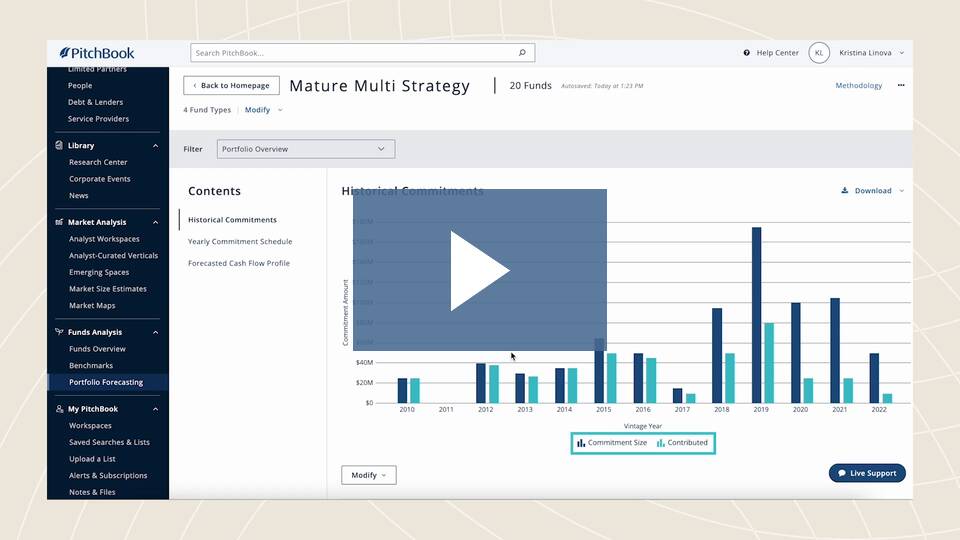
Carmean said, “Portfolio Forecasting was created to support LP clients with liquidity planning and figuring out commitment schedules. Using historical fund data, we developed a more scientific solution LPs could use. You can upload your portfolio, augment your experience with your own data, and build different scenarios within the platform.”
Here’s an example of what this looks like in the PitchBook Platform.
Conclusion
Many factors outside of an LP’s direct control can impact the overall balance of cash going in and out, making cash flow management an ongoing challenge.
While there is not one easy solution, we hope our Portfolio Forecasting tool can help you strike the right balance over time. PitchBook’s Institutional Research Group can also serve as a helpful resource, providing key insights into fund performance across different private market allocation strategies and macroeconomic conditions.
About our expert analysts
 |
Hilary Wiek, CFA, CAIA Senior Strategist |
 |
Zane Carmean, CFA, CAIA Lead Research Analyst, Quantitative and Fund Research |