
The beauty industry is undergoing a transformative shift thanks to the rise and incorporation of technology.
Driving the change are three key trends:
- The social media-centric landscape of today’s consumers
- Cultural changes in how corporations acknowledge the diversity of their customers
- An increasing importance of health and wellness in daily life
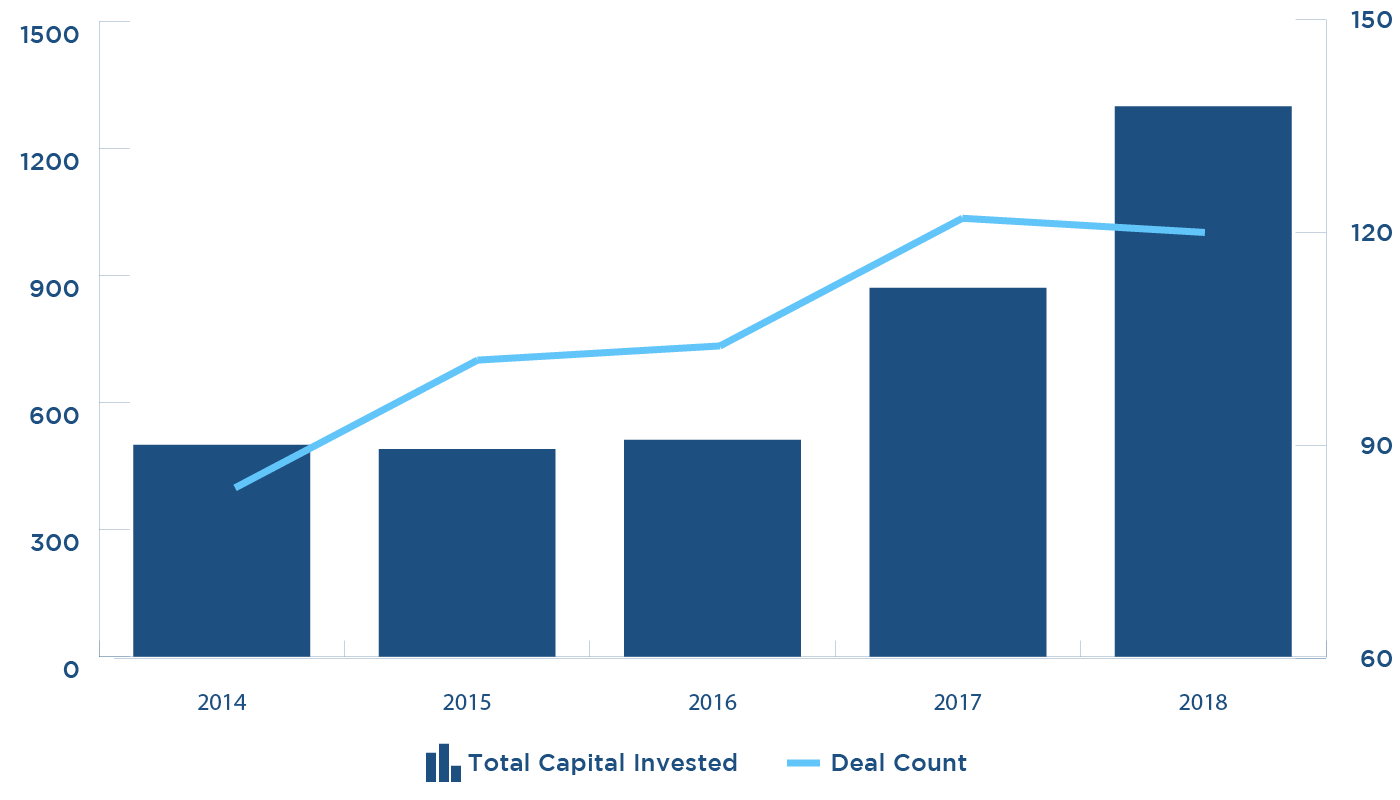
Over the last five years, more than $3.6B of capital has been invested into VC- and PE-backed companies in the beauty industry. In fact, the industry has seen an increase in deal flow each year—culminating in a record year for the beauty industry in 2018.
Notable foundings
1851: Kiehl’s started as a single pharmacy in Manhattan and now specializes in skin, hair and body care products.
1909: L’Oreal Paris first started in the hair-colour business in France and is now the world’s largest cosmetics company, owning multiple brands including Kiehl’s.
1969: Sephora first launched in Paris under a philosophy to allow customers to touch, smell and try on products—a concept that came to define the store.
1984: MAC Cosmetics were originally intended for makeup artists when the brand first launched, but are now sold directly to consumers worldwide.
2011: Ipsy capitalized on the subscription service trend and leveraged social media to grow its brand presence with influencers and beauty vloggers.
2014: Glossier beauty products were made with the intention to promote a skincare-first philosophy that celebrates beauty in real life.
2017: Fenty Beauty, founded by Rihanna, was one of Time magazine’s best inventions of 2017 for its inclusion of all skin tones and original line of 40 foundation shades.

Notable M&A deals
L’Oreal acquired Modiface, a developer of an augmented reality platform for beauty brands.
Shiseido acquired MatchCo, an app that creates individualized foundation shades for users based on their photos; Olivo Labs, a company that creates artificial skin for treating medical conditions; and Bare Escentuals, also known as Bare Minerals.
Unilever acquired Dollar Shave Club, which sells grooming products for men, for $1B in 2016. The company also acquired Hourglass Cosmetics in 2017, as an addition to Unilever’s product portfolio to help meet demand for high-quality products.
Estee Lauder acquired Too Faced Cosmetics for $1.45B in 2016, which strengthened the company’s leadership position in the fast-growing prestige makeup category globally.
Proctor & Gamble acquired Walker & Company—a health and beauty company created for people of color—in 2018 for an estimated $30M. With the acquisition, P&G will add Walker & Company’s line of products including Bevel and Form.
3 trends defining the future of beauty
- Bespoke beauty is on the rise, enhanced by growth in technologies such as augmented reality, predictive analytics, and social media platforms.
- Inclusive beauty is expanding the market by demanding more products for historically under-represented groups of individuals.
- Consumers are purchasing more products labeled as “natural” or “organic” in a shift towards health and wellness, mirroring the food industry.

