

Despite hitting a decade-high number of deals and a record deal value in 2018, dealmaking in the PE middle market was not able to keep pace in 1Q 2019. Poor performance in the public markets, paired with high financing costs due to increasing yields in the loan market, caused middle-market firms to hold off on purchases and hold on to companies they otherwise may have sold. Not all the news was bad, though, as fundraising maintained its fervent pace.
In the US PE Middle Market Report for 1Q 2019, our analysts took a closer look at these trends and broke down what they could mean for the future of dealmaking in the middle market. You can download the report for free in the link above, but if you just want to take a quick look at the highlights, we’ve got you covered with these handy charts:
Smaller deals at the same pace
Although activity in the PE middle market remained relatively on pace with previous quarters, the average value of those deals trended down significantly. In total, GPs closed on 649 deals totaling $75.1 billion, declines of 17.8% and 32.6%, respectively, from 1Q 2018.
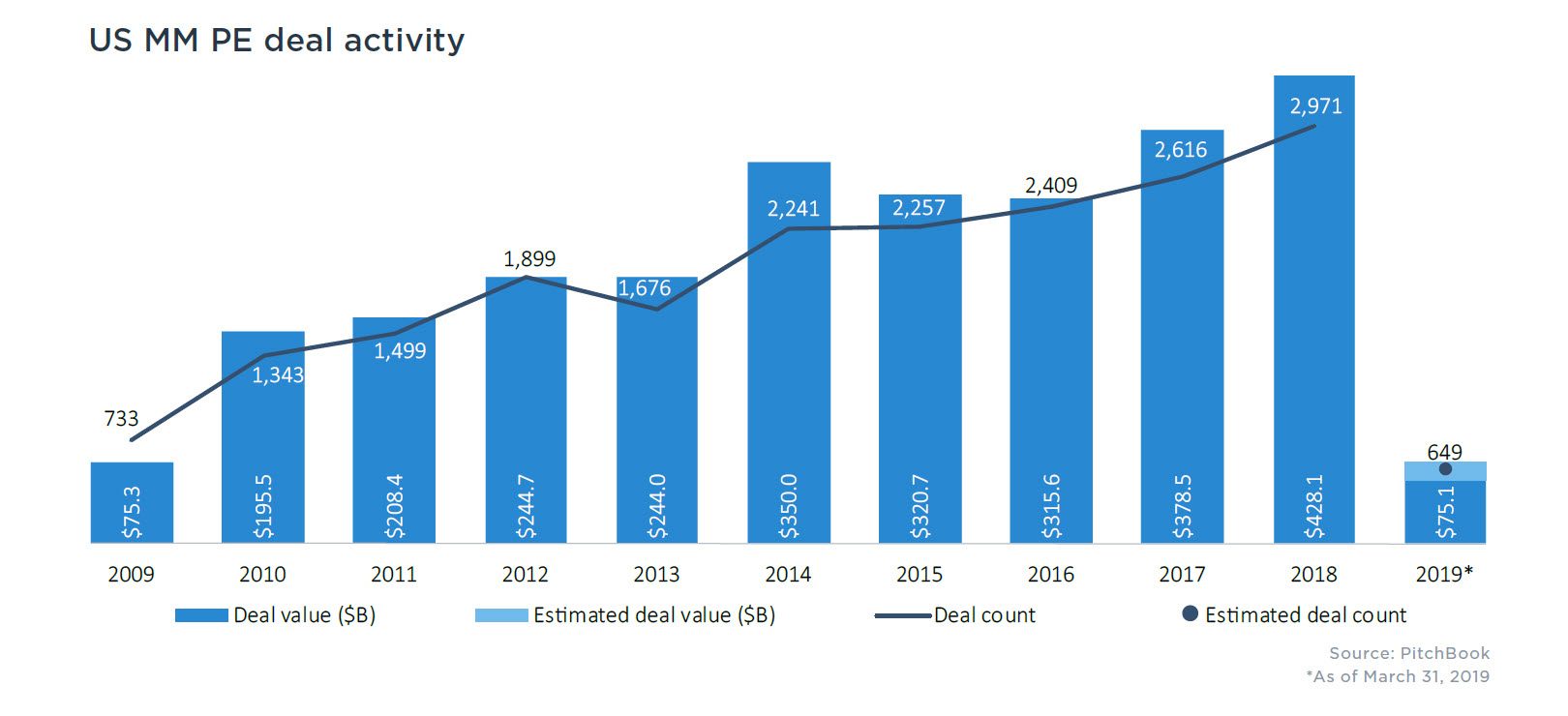
PE starts to build in China
As the global economy has become more interconnected, US investors have boosted their investments around the world. In particular, China has started to see more outside investment as the country begins loosening ownership regulation and transitions away from manufacturing and toward a primarily service-oriented economy.

Middle Market holds on to investments
Exit activity saw a steep drop-off in the 1Q 2019, with 137 companies exited at a value of $27.1 billion, a drop of 41.9% and 46.4%, respectively, from last year. The decline was mostly spurred by poor performance in the public markets that would have valued firms’ companies lower. Now, as markets have started recovering, GPs are eager to start a sale process, as fears of a recession begin to rise.

Top performers held for less time
Before the great recession, the rule of thumb for PE investing was that portfolio companies were generally held for three to five years before being exited. Firms have started moving away from that rule as buyouts become more complex and other factors, such as the 2018 change in corporate tax law, increase holding times. Fewer than 50% of MM exits now occur in under five years, and the median holding time has increased to 6.8 years.

SBO popularity holds steady
Secondary buyouts continued to be a favored way to exit investments for the middle market and PE at large, a trend that started in 2018. 1Q 2019 was also the first quarter since 1Q 2009, right after one of the worst periods for public equities in decades, that the middle market didn’t see an IPO.

Fundraising keeps elevated pace
Middle-markets fundraising kept pace at elevated levels, seeing 25 funds round up $25.7 billion for the quarter. Although our analysts do expect the longer-term trend of increasing private market allocations to stay the same in the future, performance in the public markets could potentially hinder fundraising for the rest of 2019.

Larger funds nab lion’s share
Funds over $1 billion took home the largest portion of middle-market funds, grabbing a whopping 75.3% of all capital available in the space. This is, in part, because LPs need to make larger commitments to funds as the amount of money they manage grows, pushing firms to create larger vehicles. But bigger doesn’t always mean better. According to the data, larger mega-funds have generally underperformed smaller funds with shorter and longer-term horizons.

First-time funds attract investors
First-time funds increased in popularity in 1Q 2019, comprising 20% of all MM funds raised, up from 12.6% last year and over double the five-year average of 9.6%. Of these five newcomers, three were growth funds, reflecting a drift toward growth that has been seen across all PE vehicles.

Learn about our editorial standards.
