
Should the United Kingdom remain a member of the European Union or leave the European Union?
That is the question, literally, which will appear on the ballot for U.K. voters on June 23. The latest polling results reflect a roughly 50/50 split in popular opinion between the “remain” and “leave” campaigns. The bookies are pegging the odds a little longer for Britain’s exit (“Brexit”) from the EU, making “remain” a safer bet. But an even clearer picture is emerging before the votes have been tallied: the macro-level uncertainty created by the referendum is hurting U.K. deal flow.
The idea of leaving the EU has been part of U.K. politics since it joined the economic bloc in 1973, with the first election promise of a referendum coming already in 1974. The European Union Referendum Act 2015, as it’s formally called, was introduced in 2Q last year—not long after Prime Minister David Cameron’s Conservatives, who also campaigned in early 2015 on the promise of holding a referendum, won the general election that May. The date for the upcoming vote was announced on February 20, 2016.
So, there’s been no shortage of reporting recently on potential macro-level ramifications of Brexit for the U.K.'s economy. But a lot less has been written about the effects that the referendum has already had on private equity and venture capital in the U.K., where PE and VC firms back about 3,000 companies that employ roughly half a million people, according to the British Private Equity & Venture Capital Association.
As PitchBook’s reporting on slowing European VC activity during 1Q this year found, it’s “highly probable that the Brexit wild card is spooking investors,” with a similar mood being perhaps partly to blame for the recent downturn in European PE activity over the same period. Data pulled from the PitchBook Platform suggests that increased uncertainty may have already exerted some influence with the referendum approaching, as downward trends in PE and VC deals are visible for the U.K. since spiking ahead of last year’s general election, with a distinct drop since.
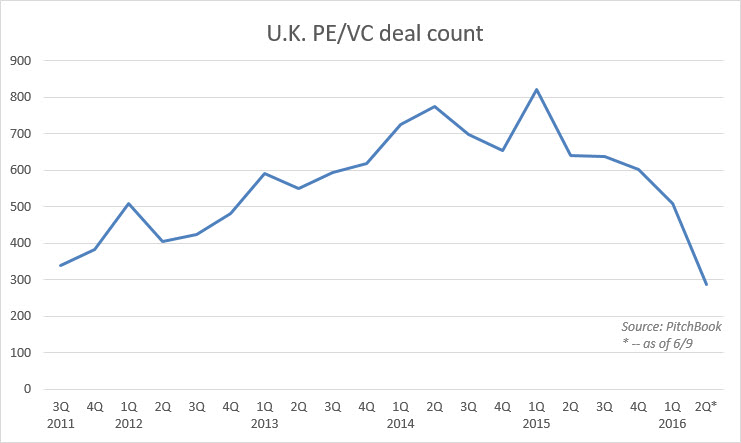
The period following the Conservatives’ victory and subsequent announcement of the referendum shows signs of slowing deal flow month-over-month.

Likewise, a downturn in deals involving non-U.K. investors and buyers started to take shape last summer following the general election.

The referendum has been a political football from the start but only claimed its first head in March, when John Longworth stepped down as director-general of the British Chambers of Commerce after coming out in favor of the U.K. leaving the EU. The BCC’s own survey of its membership shows that about two-thirds support staying. Likewise, the BVCA found similar results when it surveyed 200 “key decision-makers” between December 2015 and February 2016. A full report on the BVCA results gathered by Ipsos MORI can be found here, with the full survey available here. But in short, the BVCA found:
- 83% of business leaders of companies backed by private equity and venture capital believe that remaining in the EU would be best for their business
- 78% feel Brexit would have a negative impact on the overall economy
- 53% believe Brexit will have a negative impact on their company
The source for this pessimism is not—at least, not entirely—good ol’ fashioned British doom-and-gloom but instead the negative effects of uncertainty on doing business.
EU leaders agreed earlier this year to changes for the U.K.'s membership, including protections for the City of London’s financial services industry from greater EU regulation. Other changes, including those to immigration policy, would also go into effect even if the U.K. stays. However, as my colleague at PitchBook’s London office, Lauren Widmaier, has recently pointed out, the U.K. will still have to comply with Eurozone regulations, not least AIFMD (Alternative Investment Fund Managers Directive), the EU framework affecting the alternative fund business.
To Brexit or not to Brexit? Either way, change is already here for how the U.K.'s roughly £2 trillion economy (the world’s fifth-largest, according to the World Bank) operates within Europe. As the uncertainty created by the U.K.'s upcoming referendum has started to be absorbed by the markets, it’s becoming clear that Brexit, should it become a reality, would be bad for the private equity industry over the short and medium terms.
Featured image courtesy of Jeff Djevdet.
Learn about our editorial standards.
