
The historically buyout-heavy private equity industry is making fewer buyouts these days.
According to PitchBook’s recent Private Equity Breakdown, buyout deals have gone down as a percentage of all PE transactions in recent years. In 2004, for example, buyouts accounted for 51% of private equity transactions, while minority growth deals accounted for 17% of private equity deals that year. So far this year, buyouts have only made up 33% of all PE transactions, while minority growth investments have jumped to 25%.
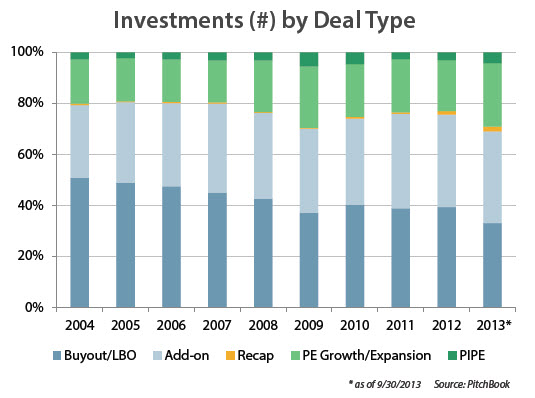
Buyouts have been shrinking as a proportion of all PE deals, while growth/expansion deals have increased.
Firms have been pivoting away from the traditional buyout model for years, looking for opportunities in less conventional markets like infrastructure, energy, real estate and high-yield debt. “You’ve seen a radical shift in what private equity has done these last few years,” Blackstone President Tony James told the WSJ earlier this year. “You’re forced to cast your nets a bit wider and find things where the space isn’t so crowded.”
The trend has continued into 2013. Blackstone made waves this February when it committed $116 million to help build a hydroelectric dam on the White Nile in Uganda. The business world is used to dealing with corporate raiders and figurative pirates, but the Bujagali Hydroelectric Power Station has had a run-in with actual pirates. It wasn’t enough to turn Blackstone away from the deal, which is expected to generate years of reliable income for the firm.

Henry Kravis and KKR have also expanded beyond the buyout. | Photo courtesy of the World Economic Forum
KKR made a similar bet in 2012, partnering with Chesapeake Energy to purchase mineral rights and royalties from property owners who were sitting on oil and gas assets. And just last week, Warburg Pincus decided to join the energy party and is reportedly planning to raise as much as $2.5 billion for its first energy-focused investment vehicle.
Other private equity firms are looking to try out new investment strategies. The Riverside Company reportedly hired a team of five “structured capital” investors from Veronis Suhler Stevenson last month. In what would be the firm’s first non-buyout strategy, the team would look for non-control junior investment opportunities in smaller, profitable U.S.- and Europe-based companies. And Tom Gores, chairman and CEO of Platinum Equity, hinted in a recent WSJ interview that his firm may also consider other strategies, such as real estate and debt-for-control investments. In fact, Platinum has already used its second fund to “test the grounds” to see how other strategies pan out.
Said Gores: “We’re definitely in a position that we could handle doing other things as long as it’s in our wheelhouse somehow.”
Learn about our editorial standards.
