
Corporate venture capital compensation is on the rise, with some CVC unit leaders catching up to their venture brethren on cash compensation.
Over the last several years, the venture investing activity of corporations has grown dramatically. The allure of investing in, learning from and potentially acquiring the next big thing has pushed long-time corporate venture arms to pick up their activity and attracted new corporations such as 7-Eleven and General Mills to open their own corporate venture groups.

Structure and compensation are two very large topics among the corporate venture crowd. These two aspects of how a company sets up its program can, at best, lead to a large venture investor valued across venture stakeholders and with a respected investment team or, at worst, be crippling and lead to poor results with high turnover. To help better understand how CVC units are compensating their teams, earlier this year PitchBook partnered up with Thelander Consulting on the fourth edition of their Venture and Corporate Venture Investor Compensation Survey. Below are some of the more interesting results.
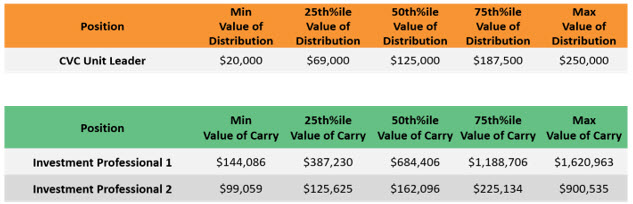
Here’s a look at compensation for senior professionals at CVC units versus VC firms with AUM under $500 million. There is pretty close parity between these two groups on total cash (base + actual bonus) compensation. There’s less parity, though, between the value of carried interest vs. the value of corporate stock and other incentives that CVC unit leaders are paid.
Base compensation:
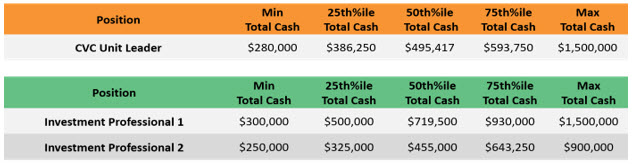
Investment-performance-based compensation:

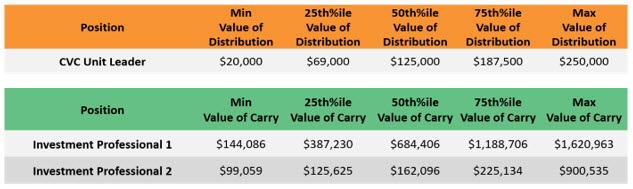
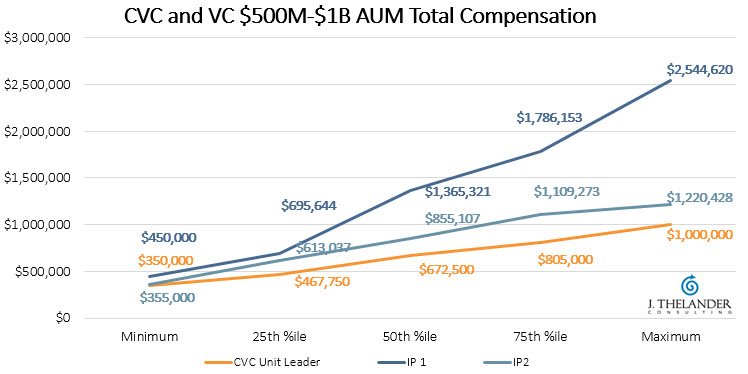
Here’s a look at compensation for senior professionals at CVC units versus VC firms with AUM between $500 million and $1 billion. The big change is that a very large gap between performance/carry compensation emerges between VC firms of this size and CVCs, even when comparing 75%ile of CVC pay (which presumably would be larger CVCs).
Base compensation:
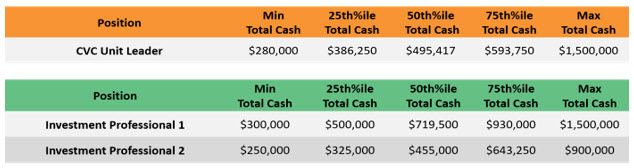
Investment-performance-based compensation:
Interested in the details behind these compensation figures and 35+ more investment firm positions (private equity, as well)? With 600 firms participating, this report is the largest and most comprehensive collection of VC, PE and CVC compensation data available today. Click here for a FREE overview of the results.
CVC unit leader: (VP or above, managing director) Plans/manages entire CVC operation and organization. Senior executive leader responsible for portfolio strategy and development, team recruitment and management, reporting and performance; interfaces with parent company executive team. Typically 10+ years of experience.
Investment professional 1: Manager of firm and partnership relationships, holds highest percent of carried interest and ownership of management company. Typically 15+ years of experience and an advanced degree.
Investment professional 2: Deal maker, board member, may be active in fundraising and high percentage of carried interest. Typically 12+ years of experience and an advanced degree.
Learn about our editorial standards.
