
Limited partners have reported lower returns from Europe-based buyout funds since the financial crisis, data from thePitchBook Platform show. Compared to funds that focus their investments in the United States, which had median IRRs of 9% in 2010, 9.7% in 2011 and 10.1% in 2012, European funds generated smaller returns for their LPs—7.6% in 2010, 6.5% in 2011 and 7.7% in 2012.
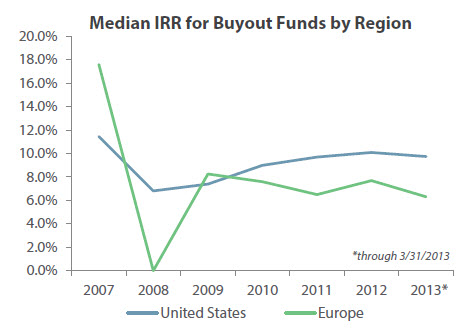
European buyout funds have underperformed compared to their U.S. counterparts since the financial crisis. | Source PitchBook
And 2013 didn’t get off to a great start for Europe-based buyout funds, which returned a paltry (by private equity standards) 6.3% in the first quarter. By comparison, U.S. funds have returned 9.8%. The United States’ relative outperformance in the post-crisis era implies a stronger deal-making and exit environment, as well as better macroeconomic fundamentals than Europe, which has suffered through its own sovereign debt crisis and other economic misfortunes since 2009.
Another metric to view relative performance of European PE funds is the horizon IRR, which looks at performance of all funds in a given bucket (in this case, U.S. or Europe) over a set period of time. For all private equity funds (including buyout, growth, co-investment, mezzanine and energy funds) in the United States, the one-year horizon IRR was roughly 11.2% for the period through 4Q 2012, according to PitchBook’s 3Q 2013 Global PE & VC Benchmarking and Fund Performance Report. The horizon IRR for European PE funds was 9.2% for the one-year period ending 4Q 2012.
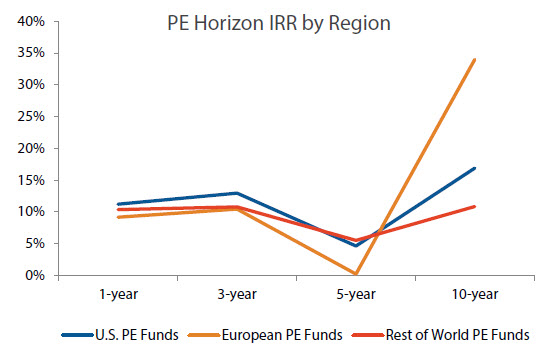
Horizon IRR data from PitchBook's 3Q 2013 Benchmarking Report show that overall PE performance in Europe over the last five years has been less than stellar. | Source: PitchBook
The three-year and five-year horizon IRRs also show similar differences for the U.S. and European PE buckets—12.9% and 4.6% for the U.S., respectively, and 4.6% and 0.2% for Europe, respectively. This essentially means that for the five-year period ended in 4Q 2012, all European private equity funds have a median IRR of essentially zero. There will be more on this and other fund returns subjects in PitchBook’s upcoming fourth-quarter edition of the Benchmarking Report.
High interest yields across much of the continent, but particularly Southern Europe (Spain, Portugal, Italy and Greece), in addition to slow growth, has put a crimp on deal-making. Buyouts are normally conducted with some debt element, and in Europe, where yields increased and credit markets tightened, it’s only natural that deal-making has declined. But it might be slow growth and high unemployment in Europe that are hitting returns the hardest, as many businesses, PE-backed or not, struggle to earn revenue from a smaller base of consumers.
This might help explain why the percentage of growth/expansion deals in Europe spiked in 2008. Growth deals rarely use debt and generally require much less equity than buyouts. In 2007, growth investments accounted for 21.1% of all private equity deals on the continent, while in 2008 and 2009 that percentage jumped to 27.7% and 29.7%, respectively.
In the United States, debt has been relatively easy for private equity firms to acquire and deal-making, fundraising and exits have all rebounded to create a positive environment for the industry to operate in.
There are signs that things are pointing up in Europe. Deal-making is on the rebound in 2013, and fundraising totals for the continent have already far surpassed 2012. These are signs that investors see light at the end of the tunnel and expect to be making more investments in the next few years.
PitchBook hopes to be with you as these trends emerge, and will provide more analysis of European deal-making, fundraising and returns over the next weeks and months in preparation for an annual European report next year.
Learn about our editorial standards.