

Gaming giant EA has agreed to acquire Respawn, the maker of the “Titanfall” video game franchise, for $455 million. The deal is the latest of several major moves this year in the entertainment software sector, which includes everything from mobile games to online gambling.
But when it comes to overall numbers, M&A activity in the space has fallen off dramatically after a record-setting 2016.
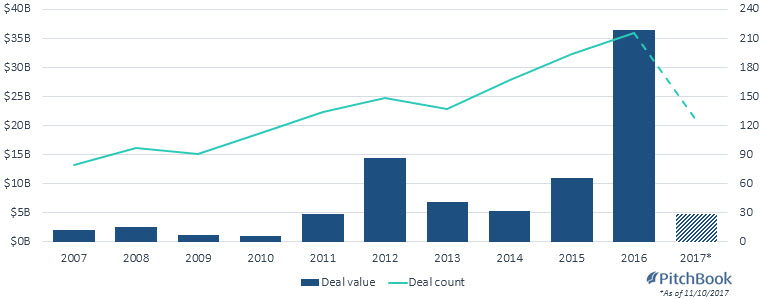
Annual deal counts have steadily leveled up over the past decade, with overall deal value closely tracking just a handful of monster deals, though. Last year was emblematic of that trend, with only two deals accounting for some $20 billion of the $36.5 billion spent across 215 total transactions, per the PitchBook Platform.
Last June, Chinese internet giant Tencent agreed to buy an 84% stake in Finnish mobile game developer Supercell from SoftBank in a $10.2 billion acquisition that ranks as the largest in the entertainment software space during the past decade. Best known for making “Clash of Clans,” Supercell boasted at the time of the deal that more than 100 million people play a title from their suite of games every day.
Earlier in 2016, Ireland’s Paddy Power and the UK’s Betfair tied the knot on a roughly $10 billion merger, the latest of a series of deals in the online gaming space. Paddy Power’s shareholders took a 52% stake in the combined company, with Betfair’s backers owning the remainder. As The Wall Street Journal observed at the time, the deal was designed to address increased costs in the face of greater regulation of the betting industry.
New year, new deals
While activity and deal value are on track to decline in 2017, the year has already played host to a pair of billion-dollar takeovers in entertainment software.
In January, London’s Outfit7, the maker of the Talking Tom app, was acquired for $1 billion by a highly improbable buyer: Chinese peroxide maker Jinke Entertainment Culture, which went on to shed Talking Tom to holding company United Luck Group just four days later. In February, meanwhile, South Korean studio Netmarble Games completed its acquisition from Kabam of the game developer’s studio in Vancouver, which is behind the game “Marvel: Contest of Champions.”
Not a subscriber to our daily M&A newsletter? Sign up today.
Learn about our editorial standards.
