

The share of at-risk issuers designated Weakest Links in the US leveraged loan market grew for a second consecutive year in 2023, and the rate of companies ultimately defaulting also rose.
LCD’s Weakest Links count — a forward indicator of potential default activity — includes companies rated B-minus or lower (excluding defaulted deals) by S&P Global Ratings that have a negative outlook or implication, and are therefore on the cusp of a downgrade to the vulnerable triple-C category.
Amid high interest expenses and financing costs, the tally of 183 Weakest Link issuers represented a 13.9% share of the overall US loan market in the fourth quarter, marking the highest year-end reading since 2020 when 18.8% of loan issuers were deemed Weakest Links.
The tally of 183 Weakest Links was up from 175 in the third quarter and 143 at the end of 2022. At the peak of the pandemic-driven downturn, in Q2 2020, 25% of the loan market, or 329 issuers, qualified as Weakest Links.

This analysis is based on credits in the Morningstar LSTA US Leveraged Loan Index. If a credit exits the index, it remains in the Weakest Links category until its rating is withdrawn or it defaults, or the issuer nets an upgrade or improvement in outlook to its corporate credit rating. The category therefore only shrinks when more loans exit the cohort than join it.
Within the Q4 cohort, an equal share at 37% are rated B-minus and CCC+. The share of issuers rated at CCC is 20%, while 6% are rated CCC-. In the Q3 cohort, 36% were rated B-minus, 38% at CCC+, 18% at CCC and 6% at CCC-.
Meanwhile, 14 of the transitions to Weakest Links within the B-minus ratings category resulted from an outlook change to negative.
Of the more pressing situations, Enviva Inc. was struck with a four-notch downgrade to CCC-, from single-B, after the producer of wood pellets for power plants reported materially weaker third-quarter results and warned of its ability to continue as a going concern as it fully drew down its revolving credit facility and engaged advisors.
The company went on to miss a $24.4 million interest payment on its 6.5% senior unsecured notes due 2026 on Jan. 16 and is operating under a 30-day grace period.
In tandem with a rising portion of riskier issuers, the share of loan Weakest Links in the cohort that have defaulted via a D or SD designation grew to 21 at year-end 2023, from 18 as of June 30, 2023, and seven at year-end 2022.

By sector, Healthcare leads with 27 Weakest Link loan issuers, followed by Electronics/Electric (LCD’s proxy for Technology) at 26 issuers and Business Equipment and Services at 15. Chemicals/Plastics saw a particularly large jump to 14 in 2023, from six issuers at the end of 2022.

Historically, downgrade activity has proven highly correlated to default activity. During the last default wave of the 2020 pandemic downturn, a jump in LTM loan downgrades (as a share of total facilities) was swiftly met by peaking default rates. In February 2020, the share of loans netting downgrades in the trailing 12-month period was 27%, while the trailing 12-month default rate of issuers in the Morningstar LSTA US Leveraged Loan Index was 2.03%. By April 2020, the downgrade share had risen to 47%, while the default rate rose to 2.71%, before ultimately peaking at 4.64% in September 2020.

More recently, as the credit environment worsened with rising rates, the LTM share of facility downgrades increased to 22% in December, from early 2022 lows of 8%.
With the uptick in downgrade activity, the share of index loan issuers rated CCC+ rose to 5.88% at the end of last year, from 4.11% at the end of 2022 and a post-pandemic low of 1.97% in July 2022.

In addition to the downward migration from rating actions, a shift in risk tolerance in the new-issue market toward better-rated credits also helped reduce the share of issuers in the secondary rated B-minus to 26% as of Dec. 31, from 29% at the end of 2022.
Note that new institutional loan volume from companies rated B-minus represented 21% of total volume in 2023, versus 42% in 2022, and 40% in 2021.
Looking ahead, the rate at which loan Weakest Links end up as defaults is unsurprisingly rising, and credit metrics imply this trend will continue.
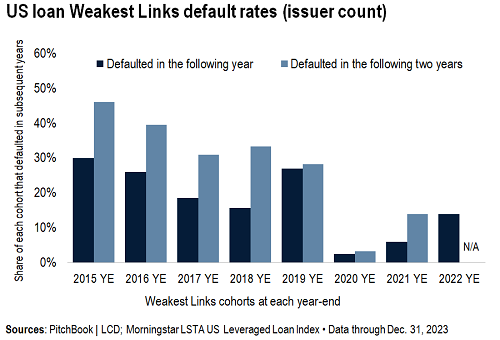
LCD’s data at the end of 2023 shows the share of borrowers designated Weakest Links in the 2022 cohort that defaulted within one year climbed to 14%, from 6% for issuers in the 2021 cohort. With interest rates remaining near long-term heights, issuers are operating with the thinnest coverage of interest expense since the early days of the pandemic, portending rising difficulties for leveraged companies in servicing their debt.
Featured Image: Andy Roberts/Getty Images
Learn about our editorial standards.
