
Santander made headlines earlier this month by announcing three investments into the fintech space on the same day. The Spanish banking giant, through its Santander InnoVentures fintech venture capital fund, took stakes in US-based Gridspace as well as UK companies Pixoneye and Curve.
The trio of investments are part of a wider push by established companies, and banks in particular, to back fintech startups. In May, for example, Barclays launched Rise London, the lender’s purpose-built hub which will house more than 40 London fintech companies, in a bid to tap into talent and innovations at an early stage.
So far in 2017, money invested in European fintech rounds with corporate venture capital participation has already outstripped 2016, per the PitchBook Platform. More than €500 million has been ploughed into the space across 40 deals involving CVCs, with investment count also on track to beat last year’s total.
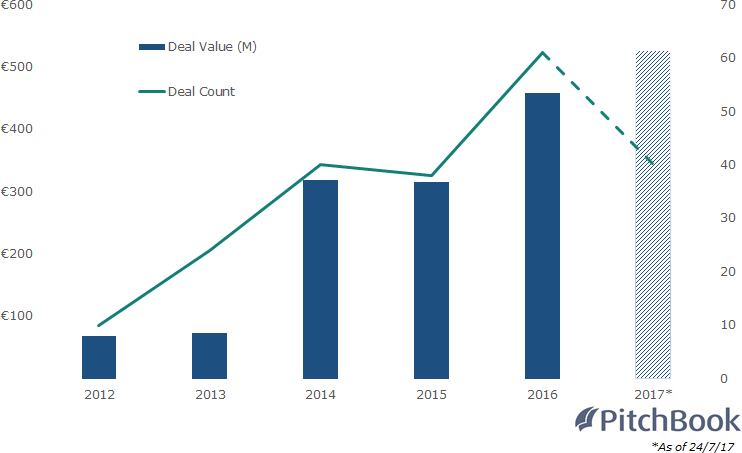
Why the step up? For one, financial services companies are facing challenges on all fronts. They have to contend with an ever-changing regulatory environment and tougher trading conditions, not to mention the uncertainty caused by the UK’s decision to leave the EU. Meanwhile, fintech startups are picking up banking licences themselves and going head-to-head with some of the established players.
A snapshot of top CVC fintech investments in Europe showcases the areas established companies are looking to dig into. Mobile payments startup iZettle’s €60 million extension in January as well as robo-advisor Scalable Capital’s €30 million investment highlight the desire of established businesses to back companies addressing needs around consumer ease and experience. Indeed, investment in payments across all deal types has skyrocketed in recent weeks.
On the other hand, deals are also becoming more common in areas which affect the very foundations of financial services. As well as the proliferation of investment in digital ledger technology such as blockchain, the acceleration of the EU’s Second Payment Services Directive, which will allow merchants and fintech companies to access bank customer data, is causing a key shift in financial services strategy. Investments such as solarisBank’s €26.3 million Series A, which included support from Arvato, is indicative of an industry wanting to harness fintech’s potential, rather than run scared from it.
PitchBook Platform subscribers can access the full data on CVC investments in European fintech.
Get more fintech coverage here.
Learn about our editorial standards.
