

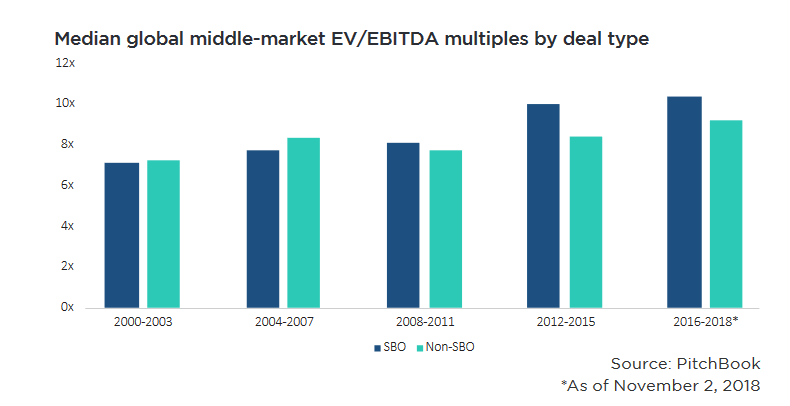
Secondary buyouts have transacted at a premium to non-SBOs since the financial crisis. That may be somewhat surprising; one could assume that “used” portfolio companies would trade at a discount given the operational improvements that have already been made, leaving less low-hanging fruit for the next sponsor. Not so in the middle market. Starting in 2008, global SBOs began outpacing non-SBOs in terms of EV/EBITDA purchase price multiples by a modest 8.1x to 7.7x, the former being the median SBO purchase price, per our latest analyst note.
The discrepancy began to widen between 2012 and 2015, which saw a median 10.0x paid for SBOs versus 8.4x for non-SBOs, and the latest batch of deals, which covers 2016 through November 2 of this year, saw a gap of 10.4x to 9.2x. In other words, starting in 2012, middle-market SBOs have been at least a turn more expensive than non-SBOs. Why?
One reason could be size, due in part to the changing profile of sponsor-backed companies. The median SBO deal size grew at a CAGR of 21.7% between 2009 and 2018, more than the 13.8% CAGR recorded for non-SBOs. Moreover, PE fund sizes have increased alongside deal sizes, with the median PE fund step-up ranging from 1.3x to 1.7x. PE-backed companies have indeed become larger and the PE industry does have more money rolling around.
For one thing, and as we’ve covered in the past, SBOs now make up a greater percentage of PE deals conducted today; they represented 17% of all buyouts in 2017 versus less than 10% in 2009. But they’ve become more expensive in the same timeframe, and as they’ve become more prevalent, it may be the case that SBO sellers are getting better at pricing those deals. If a prior sponsor has done its job of catalyzing growth and leaving more runway available, selling sponsors can price those SBOs a bit more aggressively. As the market in general gets pricier, it’s not surprising to see SBOs go up in price, as well.
There’s an argument to be made that sponsor-to-sponsor deals are a bit more sophisticated on pricing—PE funds are preoccupied with getting the best returns possible on each sale, which lends itself to stronger pricing compared to family-owned or distressed sellers.
Though the increase in SBO price may be unexpected, more of the story could be revealed once geographies and industries are taken into account.
This column originally appeared in The Lead Left.
Read more about secondary buyouts in our recent analyst note.
Learn about our editorial standards.
