
Between 2014 and 2016, the frequency of private equity-backed IPOs in the US declined by more than 50%, per the PitchBook Platform, calling into question whether it was a deal form on the verge of extinction. Last year, though, the PE-backed IPO returned with a vengeance, with the number of stateside offerings hitting 45, a 32% uptick from 34 deals in 2016, per the Platform.
Nearly 10% of 2017’s offerings involved one firm: KKR. In terms of their sectors and their stock performance in the wake of going public, these four 2017 listings help offer a snapshot of the state of the PE-backed IPO as a whole.
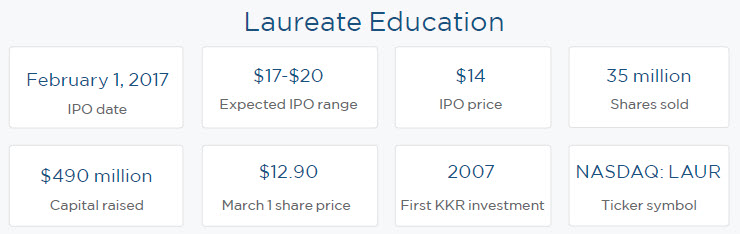
Laureate Education is an operator of for-profit universities around the world, with a network that spanned more than 70 institutions across 25 countries at the time of its public offering. KKR and a consortium that included Snow Phipps Group, Sterling Partners and others purchased the company in 2007 for a total of $3.8 billion, including $1.7 billion in debt. KKR reportedly took a $487.5 million stake at the time and increased that share to $710.8 million by 2010.
Under private ownership, Laureate expanded into 12 new countries and more than tripled its total enrollment. But it racked up additional debt in the process—raising cash to pay off obligations of nearly $4.3 billion was one of the primary goals of its IPO.
Laureate has links to Paul Allen, Steven Cohen and other luminaries—Bill Clinton once held the title of honorary chancellor. But all that clout didn’t help the company’s public offering, which was widely perceived as a letdown. Laureate priced its debut well below its expected range, and the share price plunged further on its first trading day. While the company’s stock has since bounced back a bit, it’s still never reached the heights KKR once hoped for.
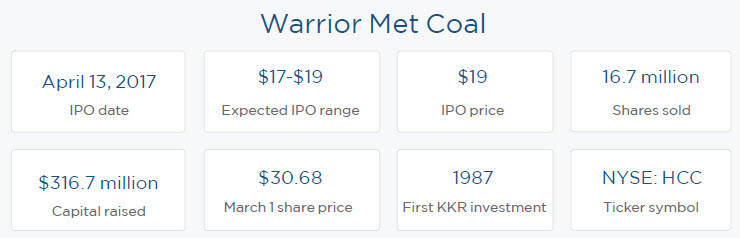
Talk about a lengthy hold time: While Warrior Met Coal wasn’t technically formed until 2015, KKR had backed Walter Industries, its predecessor company, for three decades at the time of Warrior’s public debut last year. Warrior is a producer and exporter of metallurgical coal that operates two primary mines in Alabama and has more than 300 million metric tons in combined recoverable reserves.
The company has had a checkered financial history, emerging from its most recent bankruptcy in 2015 with the new Warrior name. Apollo Global Management became the company’s largest shareholder, with a 30% pre-IPO stake, while KKR assumed a 12.1% holding and Blackstone-affiliated GSO Capital Partners took a 19.4% stake.
While Warrior’s stock floundered in the months after its debut, dipping below $16 per share last summer, it’s since recovered in a major way, shooting up past $30 per share and adding hundreds of millions to the company’s market cap.
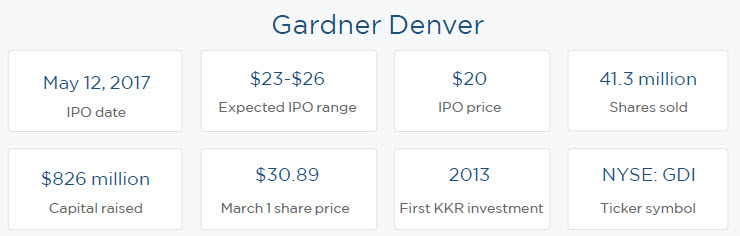
After colleges and coal, we move to the realm of compression equipment. Gardner Denver is an industrial manufacturer that makes flow-control and compression products such as pumps, vacuums and blowers for various markets. Unlike the first two names on this rundown, pre-IPO ownership of Gardner Denver was almost completely concentrated in KKR hands, as funds affiliated with the firm held a nearly 99% stake.
KKR acquired the business in July 2013 for $3.8 billion in cash. Its years of ownership met mixed financial results: While Gardner Denver’s three primary segments each improved EBITDA margins by more than 20% between 2014 and 2016, the manufacturer’s revenue declined from nearly $2.6 billion to $1.9 billion over that same period, with the company citing “a significant downturn in the upstream energy market” in an SEC filing.
Though Gardner Denver priced its IPO below its expected range, the company’s shares have gained in value by more than 50% over the past 10 months. That means KKR continues to make a profit, as the company retained a post-IPO stake of about 75%. Six months later, in November, KKR and other investors launched a secondary offering of a further 22 million shares for $27.25 apiece.
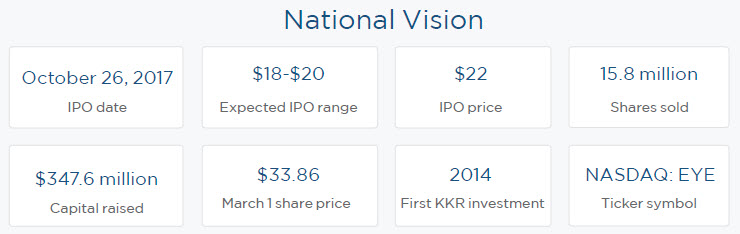
National Vision is an optical retailer in the US that operates hundreds of locations, including more than 200 inside Walmart stores. After buying the business from Berkshire Partners in 2014, KKR helped National Vision to an impressive run of growth—we took a deep dive into the relationship earlier this year.
Like Gardner Denver and Warrior Met Coal, the eyewear seller has been well received by the public markets, with its stock price trending upward since its IPO. That reflects a theme we’ve identified before: In recent years, a notable percentage of companies that went public via PE-backed IPOs have seen their values increase.
National Vision also helps further illustrate the diversity of KKR’s investments, and in turn the diversity of the overall market for PE-backed IPOs in the US. Out of the firm’s 2017 public offerings, one company runs schools, another mines coal, a third makes industrial parts and a fourth sells glasses. While some firms prefer to specialize, it’s clear KKR is comfortable investing just about anywhere. The crop of PE-backed companies to go public in the US since the start of 2012 is equally diverse, with four different sectors accounting for between 14% and 25% of all activity, per PitchBook data.
Check out more of our recent IPO coverage.
Learn about our editorial standards.
