
This analysis was included in the 1Q 2018 edition of PitchBook’s Private Market PlayBook, a collection of our most popular reports, original datagraphics and feature articles covering the key trends in VC, PE and M&A.
Private equity firms recently have become more creative in how they capitalize their businesses and have heightened their focus on the operations of their management companies. For an industry with a history of pioneering innovative deal structures and a reputation for hyper efficiency, perhaps the most surprising aspect of this evolution is that it’s taken so long.
Without going too deep into the history books, suffice it to say that PE firms’ initial efforts to tap outside capital via public markets in the late 2000s had mixed results at best. Blackstone President Tony James put it bluntly when speaking to analysts during the firm’s 1Q 2017 earning’s call: “We think the value is there, but we don’t have confidence enough in you guys to figure that out because you have disappointed us consistently.” This sentiment has been widely shared by executives of publicly traded PE firms and has served as a deterrent for other firms that may have considered an offering.
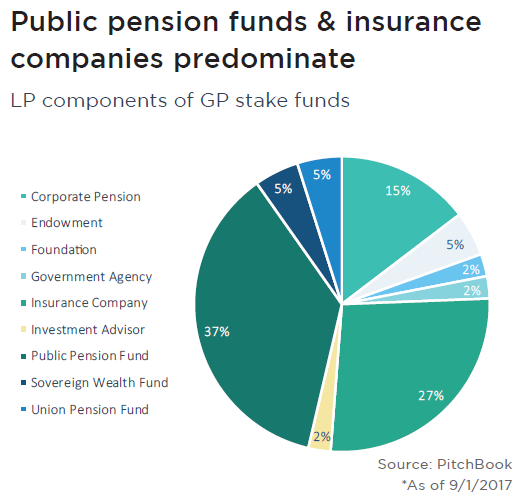
While PE firms have shied away from IPOs, their need and desire to tap outside capital has persisted. At the same time, institutional investors have sought new avenues to invest in PE firms. A solution for both sides has been GP stakes deals, whereby an outside investor acquires a minority stake in a PE firm’s underlying management company, as opposed to a fund managed by the firm. Deals of this nature have been around for a while, but they historically involved a single outside investor (often an LP in the GP’s funds) like a large pension or sovereign wealth fund. In fact, prior to going public Apollo received outside investment from both the Abu Dhabi Investment Authority and CalPERS, while Carlyle first sold a stake to CalPERS in 2001. As the PE industry has matured, however, GP stakes investing has become more sophisticated and expanded beyond one-off transactions.
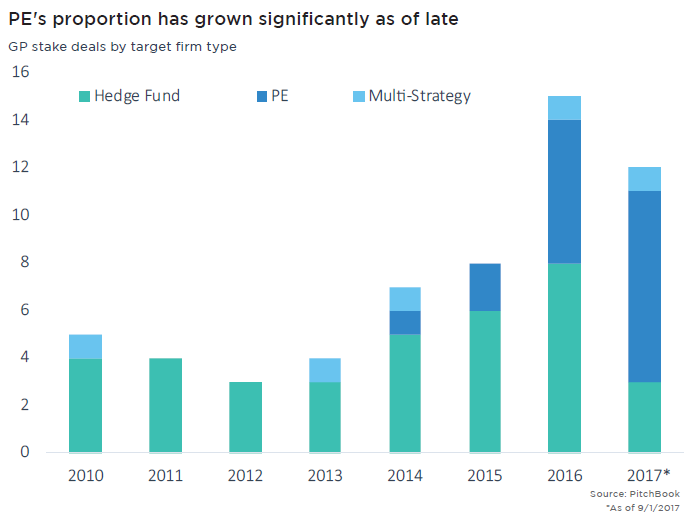
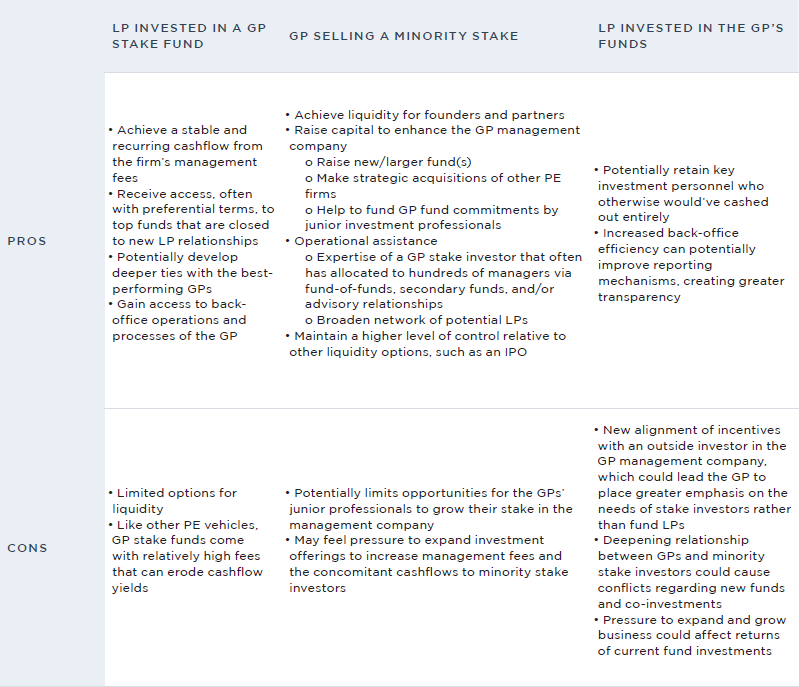
Several alternative investment firms now have dedicated GP stakes funds and teams, with a few new players entering the space in just the last few months. These GP stake deals provide a way to tap into the often-lucrative fees earned by PE firms. GPs, for their part, have leveraged these transactions to facilitate succession planning initiatives, to launch ancillary strategies, and to fund loans to junior investment professionals so that they can fulfill the GP commitment requirement of the funds they oversee.
As GP stakes investing has risen in prominence, many in the industry have questioned whether IPOs are a desirable or necessary route for PE firms. Some argue that an IPO will be the only exit option for many GP stakes deals, while others posit that many PE firms pursue a GP stakes deal specifically because they want to avoid the headaches of an IPO roadshow and the obligation to meet quarterly reporting requirements. If you can get the same access to capital in private markets as you can as a publicly traded entity, what is the point of listing?
Publicly traded PE firms may have found an answer. The latest wrinkle in this ever-evolving story is publicly traded PE firms’ newfound penchant for issuing preferred stock—a development that may have swung the sentiment pendulum back in favor of being public. KKR, Carlyle and Apollo have all recently used their standing as publicly traded companies to issue preferred shares that offer yields in the mid-single-digits—an attractive return proposition for investors in this low-yield environment. As is the case with some GP stakes deals, these preferred shares boast a call feature that allows the issuer to purchase back the securities after a given period. In addition to this flexibility after issuance, these preferred shares require neither underwriting nor a roadshow, so they can be an efficient means of raising capital (if you’ve already gone through the IPO dog and pony show). Investors have exhibited a strong appetite for these opportunities. Indeed, Carlyle reportedly doubled their initial capital target when they issued preferred shares in September 2017.
What preferred shares do not address, however, is PE firms’ acrimony with the persistent undervaluation of their shares—but developments may be coming on that front as well. A recent report by Michael Cyprys at Morgan Stanley claimed that by converting to C-corps, PE firms could “alleviate the complexities of current K-1 tax reporting and expand the universe of eligible investors in the Alts,” which could boost share prices as much as 26%.
Even with these enhancements to the public market model, we think that PE firms are unlikely to opt for public offerings when large pools of capital are available in private markets. Recent GP stakes fundraises have been met with enthusiasm. Dyal Capital closed on $5.3 billion for its third GP stakes fund in early 2017 after increasing the target by more than $2 billion during the fundraise, then immediately went back to market with fund IV. AlpInvest is targeting $500 million for its first GP stakes fund, while both Blackstone and Goldman Sachs are in the midst of deploying large funds.
Some see public markets as the eventual exit route for many GP stakes deals, but we think it is unlikely that this option would entail a full listing of the firms. Instead, a GP stakes fund may decide to package their minority stakes into a listed vehicle, which would allow the underlying firms to maintain more anonymity than a typical public company while still providing an ongoing liquidity option.
Over the next year, we expect to see heightened activity in GP stakes deals, including more investments in lesser-known PE firms as smaller GP stakes funds begin deploying capital. We think that new listings of PE firms are unlikely in the near term, but there are tailwinds for those that are already public. More innovation is certainly coming to this space, especially as founders start to turn over the reins with long-discussed succession plans finally coming to fruition. Hardly a week goes by that a new deal structure or instrument isn’t introduced, and as long as investors remain interested, one thing is for certain: PE firms will continue to seek out new avenues to tap that capital.
Check out more from the PlayBook:
The trillion-dollar question: What does record dry powder mean for PE & VC fund managers?
How fund managers are adapting strategies [datagraphic]
Data-driven investing: Why ‘gut feel’ may no longer be good enough
Learn about our editorial standards.