

Spotify co-founder and CEO Daniel Ek announced Thursday the music streaming giant will debut on the NYSE on April 3, with existing shares trading under the symbol SPOT. He and several other Spotify executives spoke on behalf of the company during its investor day in New York, a key part of the pre-IPO process that’s typically for investors’ eyes only.
Spotify, however, opted to livestream the event as part of its greater mission to be radically transparent, a strategy reflected by the company sharing insight on why it opted for a direct listing rather than a traditional IPO.
“Going public has never been about the pomp and circumstance,” Ek said as he explained the decision to hit the public markets in such an unusual manner. “You won’t see us ringing any bells or throwing any parties.”
Spotify’s direct listing differs from a traditional IPO in that only existing private shares will be issued and no new capital will be raised. The company argued during Thursday’s investor day that there’s no reason to dilute shareholders by raising new capital; instead, Spotify wants to offer liquidity to its investors by allowing them to sell shares on the NYSE as opposed to the private market.
“Any investor who wants to buy Spotify shares will be able to do so on the exchange,” the company shared in a video separate from the livestream. “There’s no underwriting syndicate, no limited float, no IPO allocations and no preferential treatment for any investor. Unlike the traditional IPO, it’s a completely level playing field.”
Spotify is still unprofitable, posting a net loss of €1.2 billion last year. It does, however, have steady revenue growth and it plans to prioritize growth above profit. In its F-1 filing, Spotify revealed that it posted €4 billion (nearly $5 billion) in revenue in 2017, up from nearly €3 billion in 2016 and €1.9 billion the year before. It’s also had positive free cashflow for the last two years.
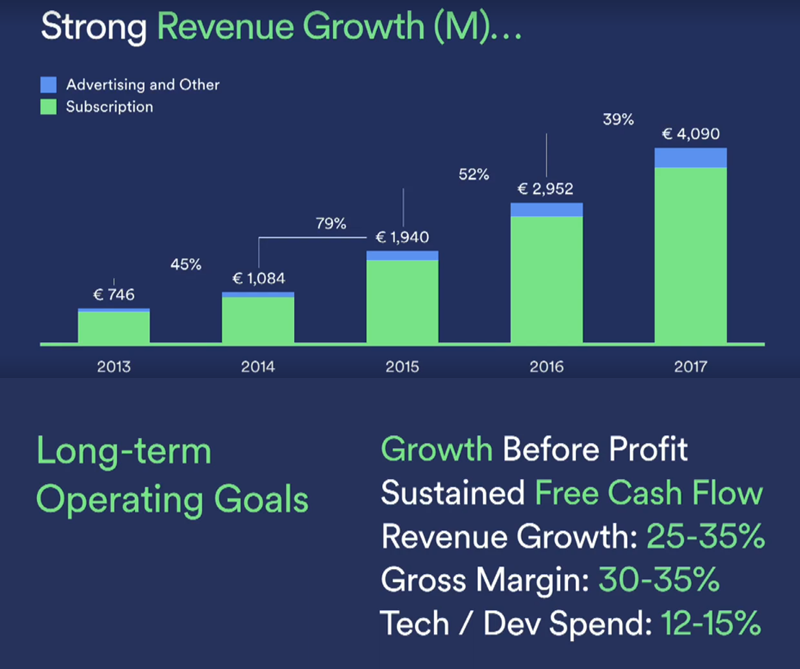
During the presentation, Ek, along with chief product officer Gustav Söderström, CMO Seth Farbman, CFO Barry McCarthy and other high-level employees, emphasized different elements of the Spotify brand that will allow it to scale as a public company. Spotify had 159 million monthly active users and 71 million premium subscribers as of December 31, 2017. Earlier this week, the company announced it had launched its service in South Africa, Vietnam, Israel and Romania. The largest proportion of its user base, 37%, is in Europe.
“We think that streaming and Spotify, in particular, has an even greater opportunity to scale, reaching billions of people around the world, so when I said we are only in the second inning. ... We don’t really think Spotify is only a streaming company anymore,” Ek said.
Spotify wants to be “ubiquitous,” ever-present and functional across all platforms and invested early in smart home tech for that reason. “We were on the first-ever Amazon Alexas and Echos ever shipped,” Söderström said. The company has similarly made sure its tech will be fully integrated into cars, a place where 30% of Spotify users listen to music. With that in mind, Spotify has, for example, inked a deal with Tesla that has all non-US Model S and Model X vehicles offering free premium streaming services.
“We see the world dividing into multiple platforms. Spotify is the only player that can work across all of them globally—Amazon in the home, Android in the car and iOS on the phone in the Western world. And Spotify can be accessed across all of it,” Ek said. “Some people say that Spotify is disrupting the music industry, but I think Spotify is really just part of the evolution of the music industry.”
Learn about our editorial standards.
