
It’s not a bad time to be in the private equity business, especially if you’re Blackstone.
The world’s largest manager of private equity assets released its 2Q earnings report Thursday, with the results mostly trending positive. Blackstone reported a 9.5% increase in the value of its buyout funds—thanks to appreciation in public holdings and private portfolio markups—which marked the highest quarterly carrying value increase since 2Q 2014. The firm also drove its total private equity AUM to $119.5 billion, a 20% YoY increase.
With its private equity business booming, Blackstone has also been able to increase prices for LPs, with fee-earning AUM up 15% YoY at $78 billion. Straight from the firm’s 2Q earnings report, here’s a closer look at the performance of Blackstone’s corporate private equity unit, which makes up about 28% of Blackstone’s total AUM:
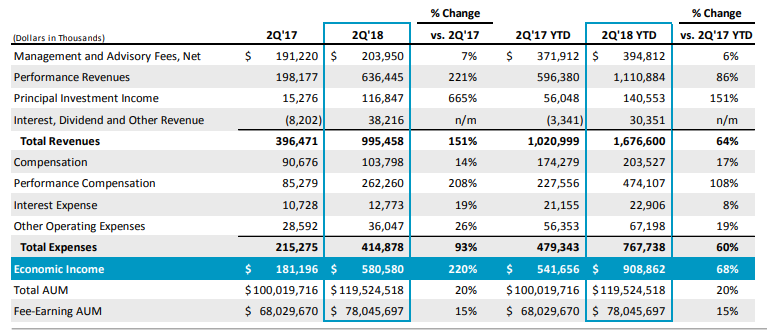
The news wasn’t quite as positive for shareholders. Blackstone’s overall distributable earnings dropped from $781.4 million in 2Q 2017 to $700.1 million in 2Q 2018. However, the firm is making some $200 million available through a special cash distribution as part of a previously announced buyback program.
Meanwhile, Blackstone’s entire holdings (which include credit, real estate and hedge funds, in addition to private equity) posted an economic net income of 90 cents per share, or some $1.1 billion, representing a staggering 56% YoY increase. Viewed as the most accurate way to gauge private equity performance, ENI represents the mark-to-market valuation of a firm’s portfolio.
Overall, Blackstone now has $439.4 billion total AUM, an 18% YoY increase. And that number will no doubt continue to rise. Blackstone founder Stephen Schwarzman announced in the earnings report that the firm’s global flagship funds will begin raising capital in the next few months. A report last week from Bloomberg indicated the firm’s next flagship vehicle could exceed $20 billion.
Despite the positive momentum, Blackstone’s stock price dipped almost 2% Thursday. The development likely irked Schwarzman, who has previously expressed frustration over the firm’s performance on the public markets. Now, Blackstone seems to be considering changing the firm’s tax status from a partnership to a corporation. In May, KKR announced it would become the second PE firm to make the switch since the corporate tax rate dropped from 35% to 21% earlier this year. The firm’s stock price has since jumped more than 22%, which caught the eye of Blackstone president and COO Jonathan Gray.
“We’ve been impressed by KKR’s recent stock performance post-conversion announcement,” Gray reportedly said on an earnings call. “We’re going to try to be as thoughtful as possible before we make a decision.”
It’s already been a busy year for the publicly-traded asset manager. In February, Blackstone named Gray, its global head of real estate, to succeed Tony James as president and COO. The firm also struck its biggest deal since before the recession, agreeing to buy a majority stake in the financial & risk business of Thomson Reuters for some $20 billion. That deal is reportedly expected to close by the end of summer.
Featured image courtesty of the World Economic Forum, photo by Remy Steinegger.
Learn about our editorial standards.
