

LAS VEGAS—PitchBook sent four of our analysts to CES in Las Vegas, where they’re sharing their takes on the tech talk, latest gadgets and industry trends likely to shape the coming year. Here’s the latest dispatch:
A preview of the ridesharing world to come
Throughout CES, Lyft has been shuttling passengers from various locations in self-driving cars developed in partnership with Aptiv. As attendees, we had the opportunity to hail one. The process was similar to hailing an ordinary Lyft, but instead of a normal car, what rolled up was a sleek BMW 540 laden with autonomous sensors, which seemed apt for a brand that advertises itself as “the ultimate driving machine.” Aptiv and BMW‘s focus on design was clear—unlike the gaudy arrays of other companies in the space, most of its sensors were smoothly integrated into the bodywork, such as the mirrors and the lower grill. Apart from the painted wheels and branding on the side of the car, one could easily mistake this BMW for an ordinary, non-autonomous vehicle.
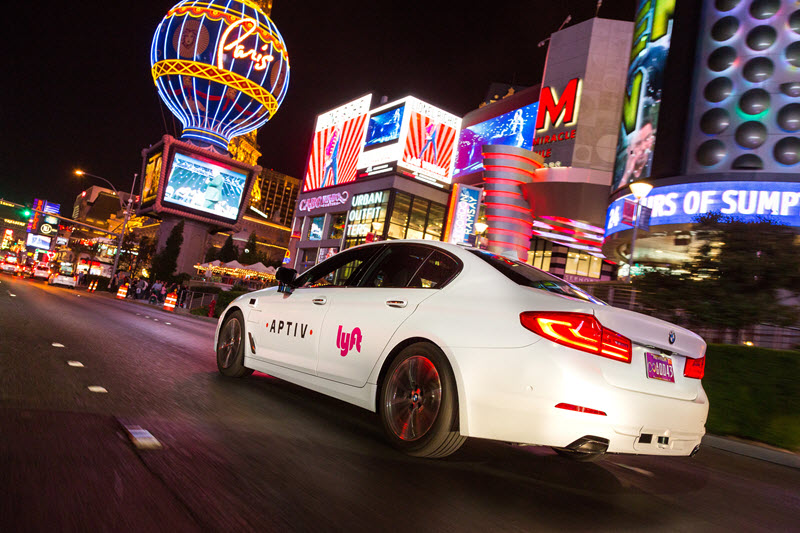
And it seemed to drive like an ordinary car—at least at first. Under the watchful gaze of the two operators in the front seats, the vehicle handled the beginning of the trip with ease, engaging in smooth steering, throttle and braking inputs. However, this changed once we hit heavy traffic. At various points, the car was hesitant, failing to complete certain movements that would be intuitive for a human driver, such as edging closer to a free lane to pass a car exiting a parking lot too close to the road. During our ride, we counted three instances where the operator had to take control of the vehicle. Observing its autonomous data feed on the infotainment screen, the vehicle appeared to lose localization at least once, and it also seemed to mistake a pedestrian crossing the street for a vehicle. Finally, when turning onto a ramp to enter a parking garage, the vehicle braked hard, as if it had interpreted something on the ramp as an obstacle.
Overall, it was clear that Aptiv’s technology hasn’t been fine-tuned, and it’s likely not yet at the level of some of the leading players in the space. This is understandable considering the millions of miles and billions of dollars in development that leading companies like Alphabet’s Waymo and GM’s Cruise have invested to get to the point they are at now.
Nevertheless, the experience was an interesting preview of what we believe is the future of ridesharing. We see autonomy as being the most transformative technology set to affect that sector, fueled by powerful economic forces driving autonomous vehicle adoption.
Simulating autonomy and the commodification of Lidar
Two years ago, the focus of the vehicle technology section of CES was the technologies enabling self-driving cars. Now, the focus seems to have shifted to also include the tech that’s adjacent to and predicated on autonomy, but which doesn’t enable it so much as augment it.
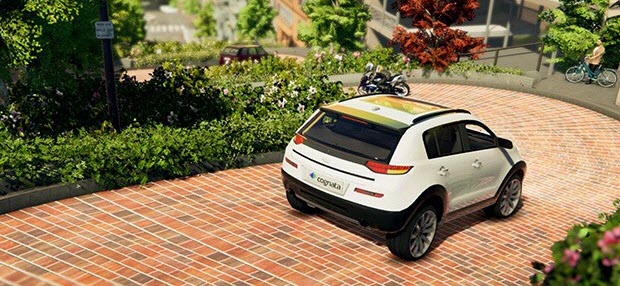
An example of this is the rise of third-party autonomous vehicle simulation software providers. These companies provide original equipment manufacturers, Tier 1 suppliers and other businesses developing self-driving cars with programs that let the vehicles accumulate testing miles via simulator. This allows self-driving cars to rack up millions of miles and be put through a huge number of scenarios, without the significant time and expense inherent to doing this in the real world. Simulation startups like Aimotive and Cognata have the potential to radically disrupt barriers to entry in the autonomous vehicle space, allowing emerging self-driving applications to close the gap on leaders in the space more quickly than if they had to physically put the cars on the road. This is a rapidly growing space and one in which we see significant opportunity for investors.
Another technology that is uniquely suited for an increasingly autonomous world is Lidar. Previously a very niche market, dozens of Lidar companies were in attendance at CES this year, taking up huge sections of the vehicle technology conference center. The sheer number of new entrants, many of whom were based in China, serves to indicate that this is a rapidly commodifying hardware business, likely susceptible to significant pricing pressure in the future. This sentiment was echoed in conversations with companies in this space, many of whom are attempting to reposition toward software. We expect the space to consolidate over the next few years to include far fewer names and the most successful startups to be differentiated by their focus on software, like Seoul Robotics.
Learn about our editorial standards.