

This post is part of our ongoing coverage of TechCrunch Disrupt
SAN FRANCISCO—Before Uber, Lyft and Airbnb, there was Dropbox. The company, one of the original cloud-based file-sharing businesses, has received a lot of attention in tech circles since it was founded in 2007, including plenty of buzz surrounding its IPO earlier this year.
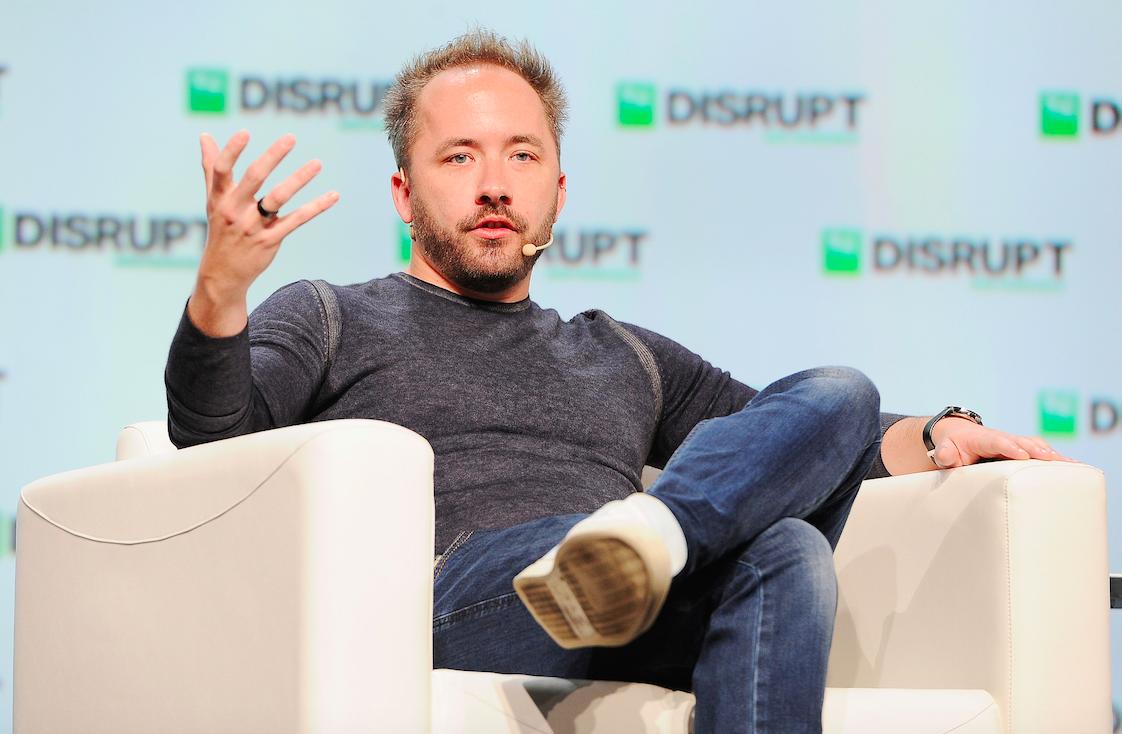
Dropbox made headlines in March when it went public in one of the most-anticipated IPOs in recent history, raising more than $750 million and valuing itself at around $9 billion on a fully diluted basis. Drew Houston, who co-founded the company and launched it at TechCrunch Disrupt back in 2008, took the stage at this year’s event to discuss leading Dropbox on the journey from scrappy startup to public company.
For Houston, taking his company public was a natural evolution. He didn’t run into much trouble raising venture capital once Dropbox was an established company. Before it went public, the business raised more than $600 million from VCs including Sequoia and Accel, reaching a final private valuation of $10 billion.
“Investors would kind of get out in front of us,” Houston said. “When you get to the growth-stage investment phase, there aren’t that many companies, but there’s a lot of capital.”
In 2015, Houston and his team started to think seriously about the mechanics of taking Dropbox public. He knew he would have to keep a close eye on things like revenue, profitability (or lack thereof) and number of paid users. The company became cash flow positive in 2016, two years before its IPO.
“It’s important to begin with the end in mind. … It’s important to understand where you’d be as a public company,” Houston said onstage. “As a private company, your scorecard or report card will be things like, ‘How much momentum do you have? How excited is everyone? How many users do you have?’ But on the other side, when you’re a public company, investors will grade you pretty clinically: ‘How much money are you making?’”
There are disadvantages to being a public company, including the almost singular focus on financials. But Houston said that in the half year since Dropbox went public, he’s noticed a lot of advantages, as well—including the ability to offer liquidity to some of his earliest employees. And the necessity of disclosing everything about his company’s operations also has its perks.
“What [the employees] hear from me and the management team at an all-hands and what they read in the press and what they hear on earnings calls and what they see in their bank account is all the same thing,” Houston said. “And that’s different from kind of the late innings of being a private company, where there’s no transparency, kind of by design.”
Now that Dropbox’s IPO is behind him, Houston says he’s focused on developing the company and moving it into the future. A decade ago, people were still using USB drives to store files, so Dropbox’s focus was moving files onto the cloud. Now that cloud storage is the norm, the company is moving into other workplace collaboration tools, including Paper, a new tool for editing documents. In very general terms, Houston says Dropbox is trying to “make work a more organized experience.”
It’s been a long road. Looking back on his first time on the TechCrunch Disrupt stage back in 2008 “makes me twitch a little bit,” Houston said. “Our launch was not our finest moment. Like, it’s actually kind of hard to imagine how that could have gotten worse.”
But fast-forward 10 years, and his company is one of the major Silicon Valley success stories, with a big exit for investors and early employees. “Just know that it’s a roller coaster, and know there’s no button that a founder can press that says ‘Please just make things go up and to the right,’” he said. “Think of it more as an adventure.”
For more on Dropbox, check out our datagraphic on the company’s IPO.
Learn about our editorial standards.
